
Nothogymnomitrion erosum
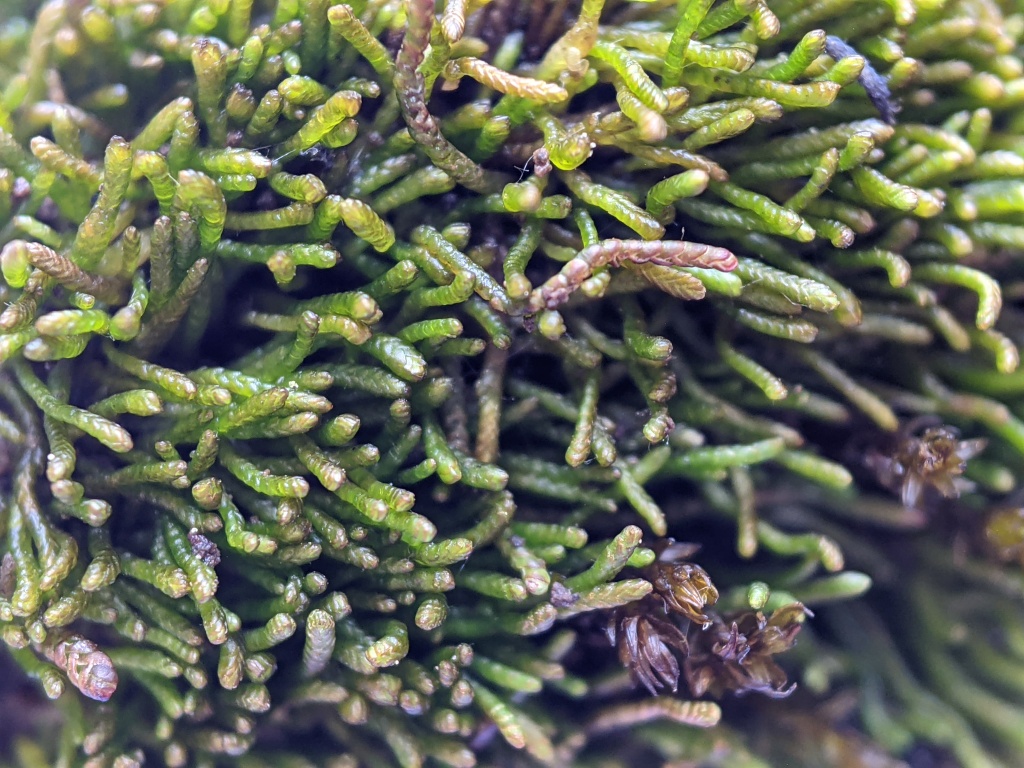
(Carrington & Pearson) R.M.Schust.Greenish to golden brown or red-brown mats or short cushions. Shoots wiry, julaceous. Leaves orbicular-ovate, 200–500 µm long, 175–580 µm wide, erect to appressed to stem, plane at margins, denticulate by projecting cells, often becoming eroded with age. Leaf cells in marginal 1 (–2) rows differing drastically in form from other cells forming a border; leaf cells away from margin 12–30 µm long, 11–19 µm wide, coloured but becoming hyaline toward marginal cells; marginal cells more elongate, ovate with projecting knob-like ends, 12–40 µm long, 7–18 µm wide, thick-walled, hyaline and devoid of contents. Bracts in several series, becoming larger than leaves and more coarsely denticulate, but otherwise similar to leaves. Bracteoles present near perianth, usually connate on one or both sides with bracts, sometimes broadly so and the bracts and bracteole appearing like a 3-lobed bract.
EGU, VAlp. Widespread throughout the Victorian Alps where a common component of bryophyte communities among rocky cliff lines and outcrops in the alpine zone. Also, New South Wales, Tasmania, New Zealand, Chile, Tristan da Cunha, Falkland Islands and South Georgia.
Often confused with Syzygiella teres (see notes under that species). This species is also similar and often growing with Gymnomitrion incompletum, however, the latter species has more deeply bifid leaves and lacks the characteristic margin of elongate cells with thick cell walls and knob-like ends.
 Spinning