
Syzygiella sonderi
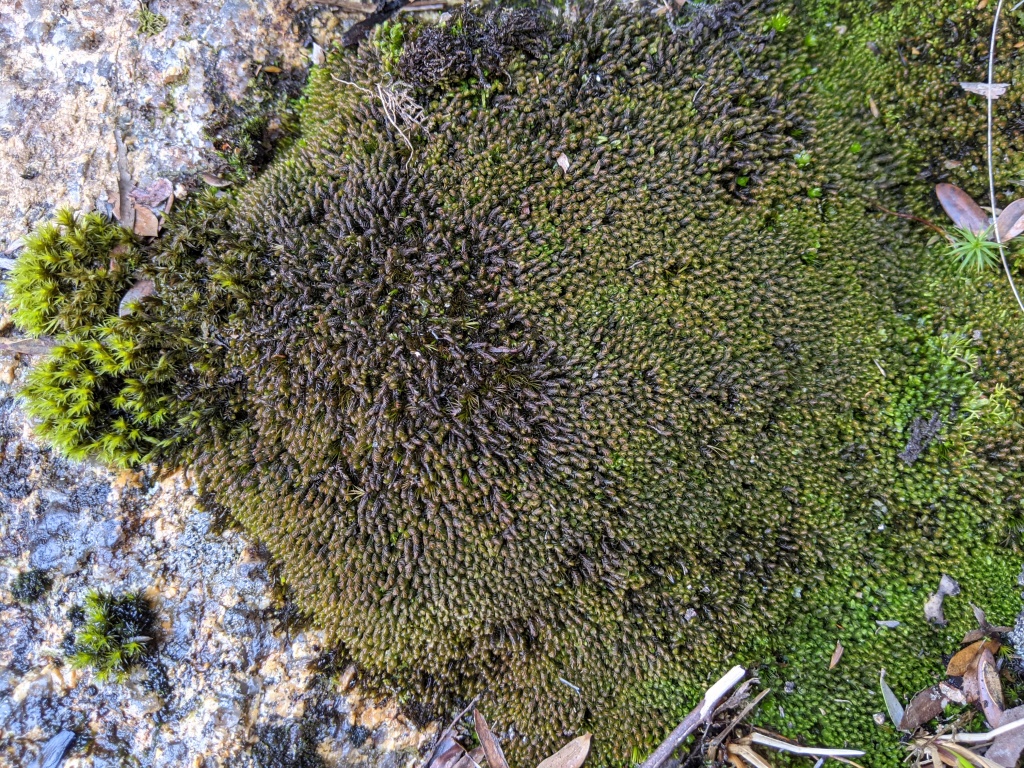
(Gottsche) K.Feldberg, Váňa, Hentschel & HeinrichsTufts on soil or rocks, often in streams, green, brown-green, becoming blackish in exposed sites. Specialised asexual propagules absent. Leafy stems ascending from stolons; stems without or with inconspicuous acicular paraphylia dorsally; branches emerging from ventral side of stem. Leaves broadly elliptic to orbicular or oblate, 625–2500 µm long, 425–3000 µm wide, weakly succubous to transverse, spreading from stem and squarrose, decurrent, unistratose, entire, with plane to involute margins, rounded or sometimes retuse at apex. Underleaves absent or vestigial, uniseriate and caducous. Leaf cells mostly quadrate, 12–30 µm long, 12–28 µm wide, becoming short-rectangular in basal centre and 37–90 µm long, 15–25 µm wide, indistinctly striate-papillose or smooth, evenly thin- to firm-walled, without trigones; oil bodies pale smokey grey, 2–8 (–10) per cell, papillose. Rhizoids mostly confined to stolons, occasionally on ventral side of prostrate leafy shoots. Androecia on leading shoot, with up to 7 pairs of saccate bracts, each with a single antheridium. Bracts closest to perianth broadly obovate to oblate, unlobed to laciniate with several divisions, sometimes with additional lamellae near base; bracteole narrowly lanceolate, similar length as bracts, fused with one or both bracts for 0.3 of its length, with 1–2 lobe-like teeth on one or both margins, sometimes with additional lamellae near base. Perianth ellipsoid, plicate in apical half to near base, twisted toward apex, shallowly and bluntly lobulate, without teeth at mouth. Capsule ovoid-ellipsoid, 5–7-stratose; spores papillose or vermiculate; elaters bispiral.
GGr, HSF, HNF, OtR, VAlp. Beside creeks or in seepages among rock outcrops mostly in alpine areas, but also in montane streams and in the Grampians. Also, New South Wales, Tasmania, New Guinea, New Zealand, southern South America, Tristan da Cunha and Subantarctic Islands.
 Spinning