
Gongylanthus scariosus
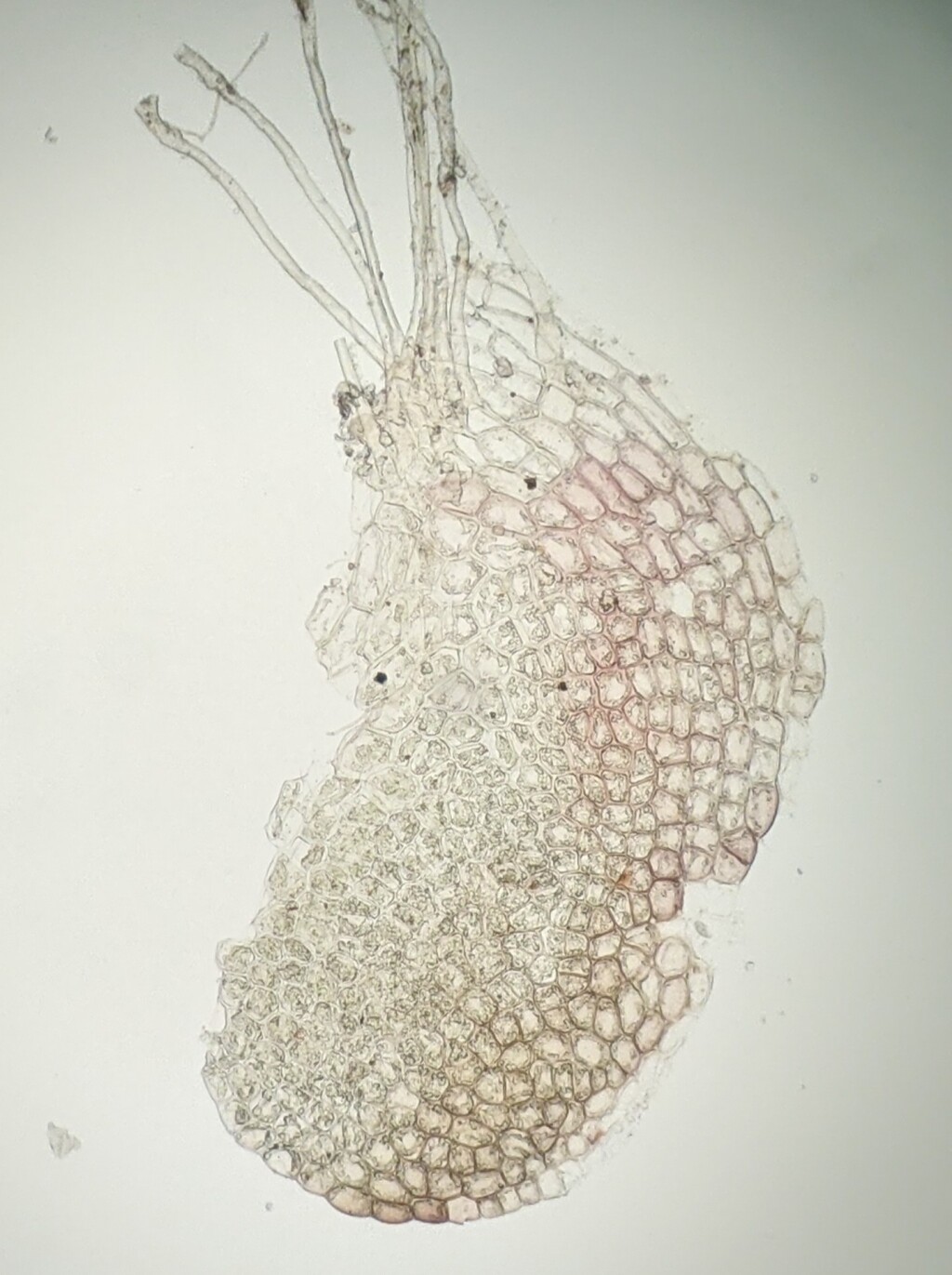
(Lehm.) Steph.Plants silver-white to pale green. Stems creeping, embedded into substrate, green. Leaves auriculate, 325–600 μm long, 575–1125 μm wide, oriented upwards away from substrate, densely imbricate, adaxially concave, opposite and sometimes narrowly connate dorsally or ventrally with opposing leaf. Rhizoids in bands connected ventral leaf bases. Leaf cells in basal field polygonal, 27–43 μm long, 20–35 μm, thin-walled with distinct trigones, becoming thick-walled toward apex, often cells pigmented magenta at transition zone, elongate and thick-walled along ventral margin near base where 37–70 μm long and 11–30 μm wide, sometimes elongate cells also at base of dorsal margin or extending along entire margin, smooth, sometimes papillose abaxially, with 4–14 oil bodies; oil bodies spherical to ovoid, hyaline, homogeneous. Androecial bracts with a single antheridium. Marsupium subterranean, to 2 mm long, cylindric, covered in rhizoids. Capsule cylindric.
Wim. Known in Victoria from open sites in woodland on compacted clay or silty soil, mostly from northern and western Victoria, but also around Melbourne. Also, Western Australia, South Australia and South Africa.
This species has been confused with Lethocolea pansa that looks superficially similar and occupies similar habitats. However, the opposite and ear-shaped leaves that are all strongly directed upwards away from the substrate and the marginal band of thick-walled cells are features not shared with L. pansa and makes G. scariosus highly distinctive.
Beckmann, K.G. & Scott, G.A.M. (1989). Gongylanthus scariosus (Lehm.) Stephani – a liverwort new to Australia. Lindbergia 15: 79–84.
 Spinning