
Nymphaea 'Colonel A.J. Welch'
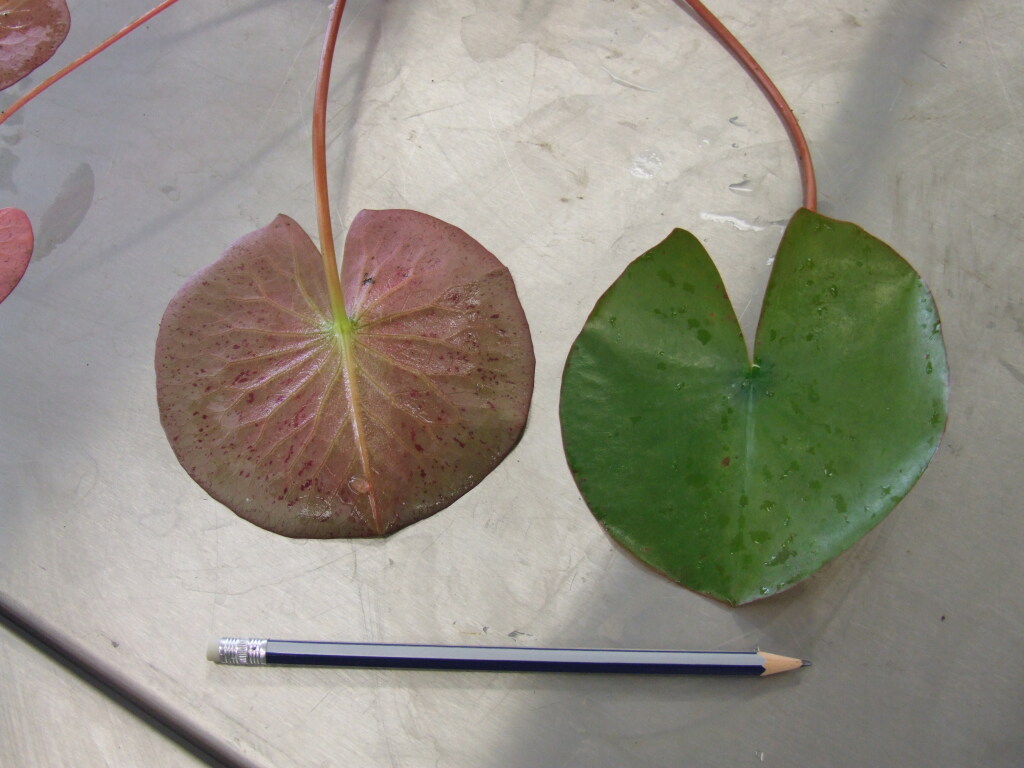
Yellow WaterlilyRhizomes horizontal, to c. 50 cm long, c. 5 cm thick, Marliac-type, stout, knobbly, fleshy with short (c. 5 cm) projecting branches to c. 1 cm thick along its length, yellow; roots long, fleshy, unbranched, prolific, arising from knobbly projections, dominant leaves and petioles arising at rhizome apex, secondary leaves and petioles arising from projecting branches; stolons present, new plants produced from buds (stolon-like, 3-20 mm long). Leaf lamina orbicular with a radial sinus, 15–30 cm diameter, light green on upper surface, with small purple / maroon blotches; lower surface light purple / maroon with abundant darker flecks or blotches; lateral veins joining before the margin. Petiole with several large aerenchyma, light purple, no pubescence, light green at junction with leaf; margins barely sinuate. Flowers to c. 12 cm diameter, scant, held on or above the water, open in the afternoon, closing at night; often viviparous, new plants with rhizomes and dense root balls produced rapidly from fresh flowers, remaining attached to parent plant via peduncle for at least several weeks. Peduncles maroon, no pubescence. Sepals four, light green to white. Petals c. 25, elliptic, acute, the outer petals pale yellow, the inner petals golden, grading into petaloid stamens. Stamens numerous, yellow. Berry ovoid. Seeds (rarely formed in Australia) many, c. 2-5 mm long. Flowers mostly summer.
Also naturalised Qld, NSW, ACT.
The taxon described here appears consistent with the hardy cultivar Nymphaea ‘Colonel A.J. Welch’ (Slocum, 2005), a Marliac cultivar of unknown parents. In Victoria this taxon has previously been referred to as Nymphaea mexicana, or Nymphaea mexicana hybrid. However, N. mexicana is unknown to be naturalised in Victoria. The Victorian plants do not have vertical rhizomes, long stolons or brood bodies (banana bodies) that are characteristic of N. mexicana. Likely to be the main weedy yellow water lily that occurs elsewhere in Australia that is currently regarded as being Nymphaea mexicana or N. mexicana hybrid.
In Victoria, naturalised along an anabranch of the Goulburn River near Nagambie, Lake Benalla (associated waterbodies), Casey’s Weir, Gunbower Creek, Loddon River at Bridgewater.
A serious environmental weed in lakes and river anabranches. A robust waterlily, characterised by abundant vegetative growth with expansion of colonies and downstream dispersal accelerated by viviparous formation of robust, fully formed plantlets (pups) from fresh flowers. Historically available in the nursery trade but is now rarely if at all available due to its scant flower production. The yellow waterlily that is currently (2026) commonly available in the nursery trade as N. marliacea ‘Marliacea Chromatella’ (Slocum 2005), which differs from Nymphaea ‘Colonel A.J. Welch’ in that it has a vertical (pineapple)-type rhizome (5-12 cm thick, with tendency to be branched), flowers prolifically, does not produce viviparous flowers, and is vegetatively less prolific with a smaller leaf spread (to 0.9 m).
Slocum, P. D. (2005). Waterlilies and lotuses. Species, cultivars, and new hybrids. Timber Press.
https://natures-water.com/education_information/resources/pond_plants/aquatic_plant_propagation.pdf [accessed 2 March 2026]
This treatment is co-authored with Tony Dugdale.
 Spinning