
Lejeunea drummondii
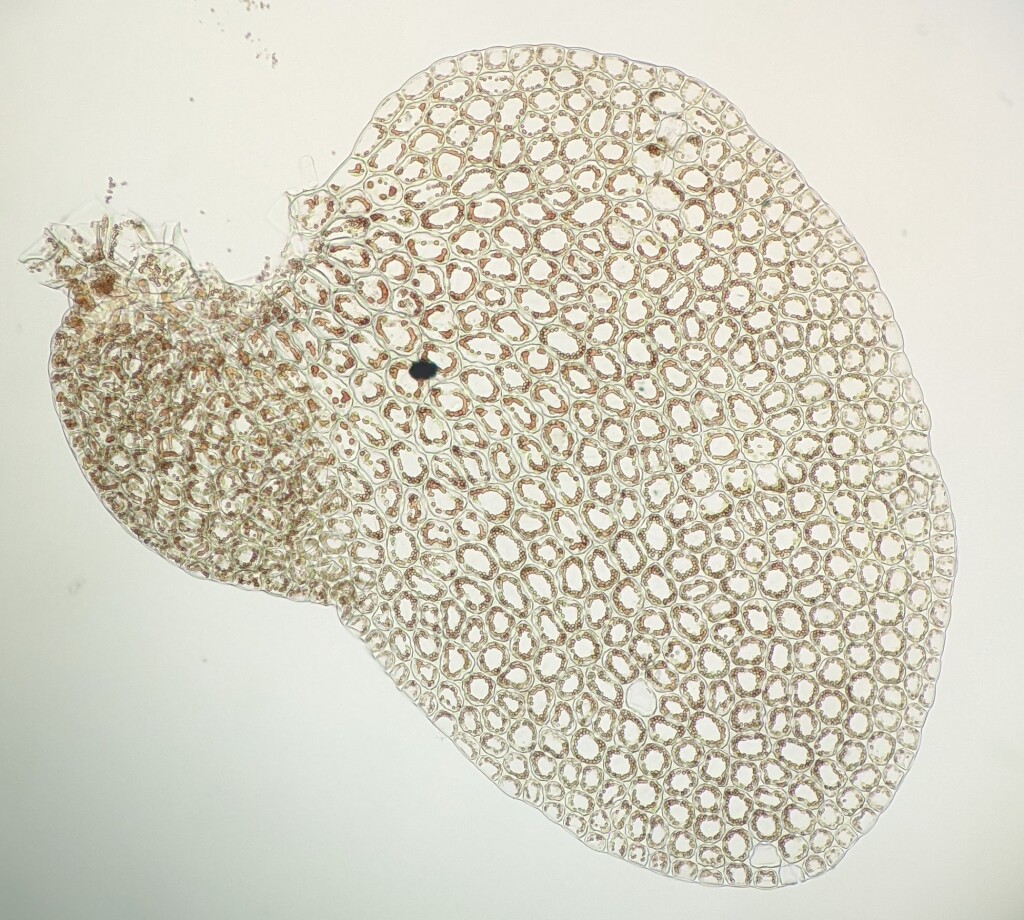
TaylorPale to lime or yellow-green mats on branches, trunks, logs and rocks, paroicous or autoicous. Specialised asexual propagules absent. Leaves imbricate, 320–875 μm long, 310–800 μm wide, directed slightly in direction of stem apex, minutely crenulate by slightly bulging cells, extending to beyond opposite edge of stem dorsally and completely obscuring stem from above; lobe elliptic, rounded to weakly obtuse at apex, margin weakly crenulate by slightly bulging cells and in most leaves descending in direction of stem base below level of keel apex forming a distinct notch at keel apex; lobule sometimes weakly developed and confined to basiscopic ventral axil of leaf near stem base and transitioning to become well developed and inflated toward stem apices, ovoid, 175–320 μm long, 125–210 μm wide and with an outwardly bulging keel when well-developed, with tooth furthest from stem directed c. parallel to stem, always composed of a single non-elongate cell. Leaf cells polygonal, 21–55 μm long, 20–33 μm wide away from margin, smaller at margin where 12–23 μm long and 10–17 μm wide, thin-walled, with small trigones and intermediate thickenings, smooth, with more than 30 homogeneous spherical to fusiform oil bodies arranged in submarginal ring. Underleaves elliptic-ovate in outline, 175–500 μm long, 195–500 μm wide, contiguous to imbricate, with margins near base not extending beyond point of attachment in direction of stem base; lobes 1/3–1/2 of underleaf length, separated by a narrow V-shaped or ligulate sinus, acute or obtuse at apex and acute or rounded at base. Perianth pyriform, distinctly 5-keeled, 825–1100 μm long, 350–500 μm wide, with a short beak 2 cell tiers long, with apical tier composed of elongated cells. Underleaf at junction of innovation below perianth elliptic in outline, overlapping with bract gyre immediately below perianth.
GleP, OtP, WaP, CVU, GGr, EGL, EGU, HSF, HNF, OtR, Strz, VAlp. Widespread and common in rainforest, riparian vegetation and wet sclerophyll forest along and south of the Great Dividing Range, most commonly occurring as an epiphyte but also rarely as a lithophyte. Also, Western Australia, South Australia, Queensland, New South Wales, Australian Capital Territory and Tasmania.
 Spinning