
Lethocolea pansa
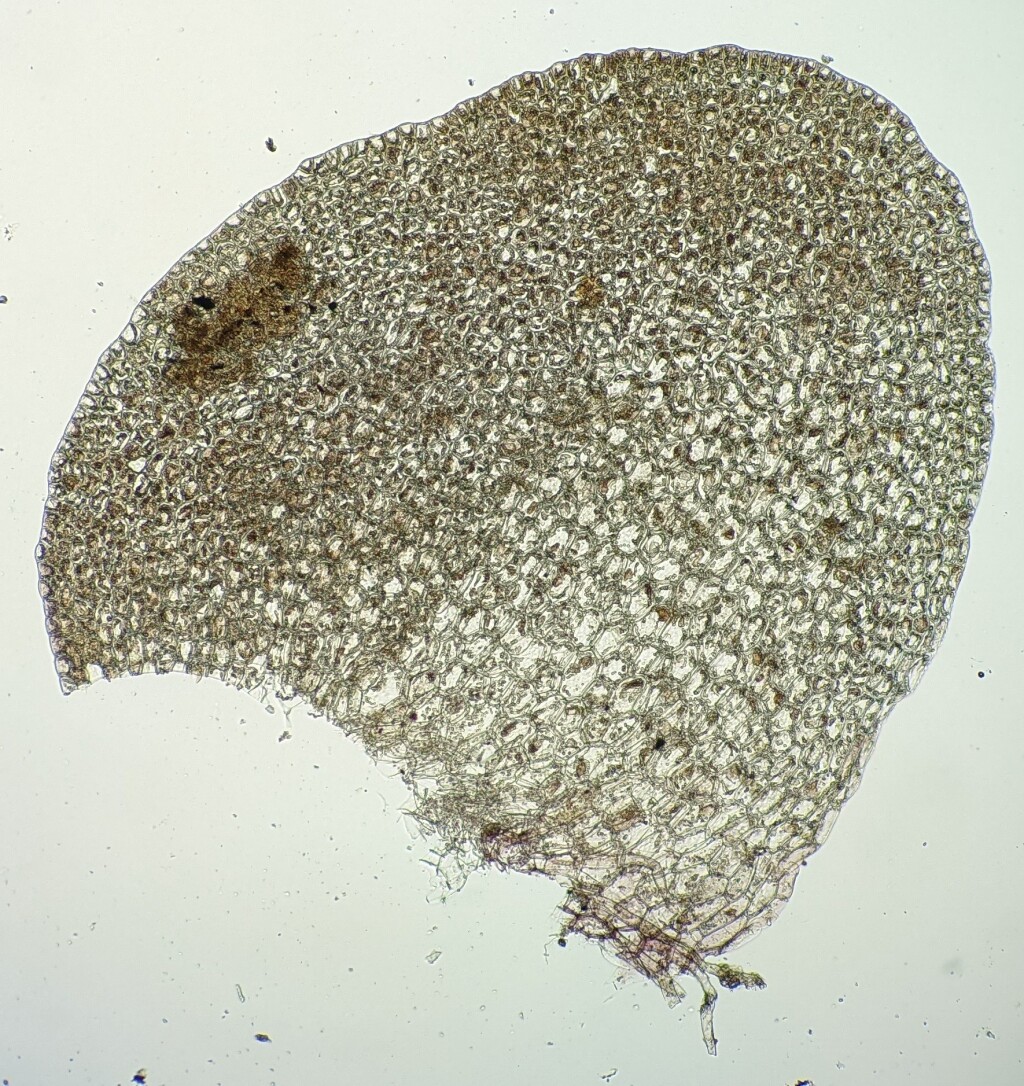
(Taylor) G.A.M.Scott & K.G.Beckm.Plants pale- to olive-green or burgundy. Stems creeping, often slightly immersed into substrate, burgundy to rose ventrally, green dorsally; branches sparse, emerging from stem from the ventral end of an unmodified leaf. Asexual reproduction rarely by discoid gemmae produced on adaxial stem near apex. Rhizoids white. Leaves asymmetrically ovate to ligulate, 475–2175 μm long, 350–1525 μm wide, rounded at apex, wide-spreading with the dorsal margin ascending away from substrate, then leaf apex arching back toward substrate, alternate, entire. Underleaves vestigial. Leaf cells polygonal, thin-walled, indistinctly papillose to distinctly striate papillose, elongate in a field extending from basal centre to the ventral margin to around half way to apex, 45–128 μm long, 22–48 μm, otherwise mostly isodiametric and with larger trigones, 22–54 μm long, 15–35 μm, most with a single large oil body; oil bodies irregular to ellipsoid, orange-brown to brownish grey, granular. Gynoecium terminal on leading shoots. Bracts larger than vegetative leaves, otherwise similar. Marsupium long-cylindric.
Wim, GleP, VVP, GipP, OtP, Gold, CVU, GGr, DunT, NIS, WPro, HSF, OtR, VAlp. Widespread on clay soils in open sites, mostly in drier areas along the Great Dividing Range and its northern foothills, but occasionally in wetter regions and sites from near the coast to subalpine peaty swamps. Also, all other states of Australia, Australian Capital Territory, New Zealand and New Caledonia.
This species is superficially similar in appearance to the rarer Gongylanthus scariosus that occupies the same habitat. However, G. scariosus has opposite and ear-shaped leaves, much wider than long, that are all strongly directed upwards away from the substrate and and marginal band of thick-walled cells in the leaves.
 Spinning