
Acrobolbus tenellus
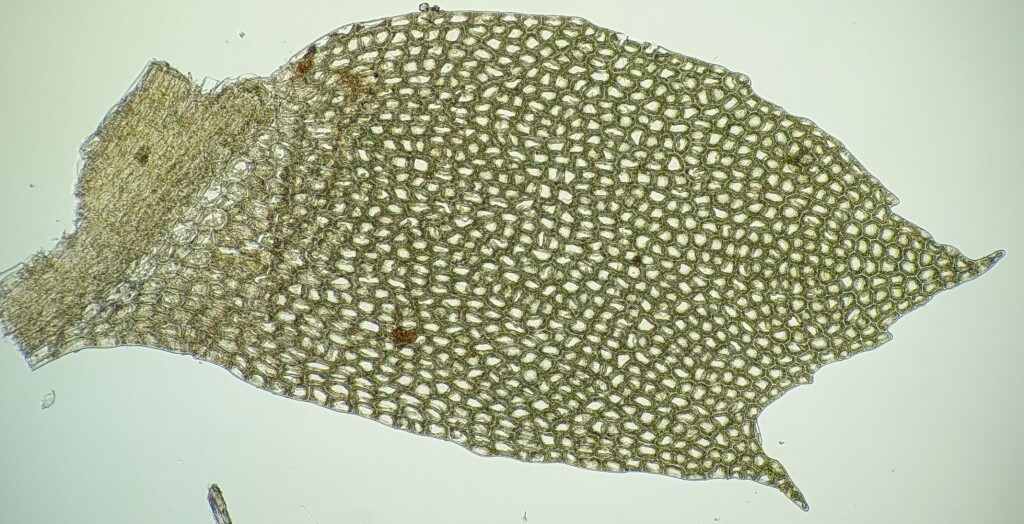
(Lehm.) Trevis.Plants lime green. Stems creeping to erect, smooth, with a poorly developed system of stolons; branches common, emerging from stems laterally and not associated with a narrower leaf or rarely when emerging from near base of erect shoots, emerging ventrally. Specialised asexual propagules absent. Rhizoids hyaline, scattered, on stolons and bases of erect shoots. Leaves oblong to rectangular or obovate in outline, asymmetrically bilobed or retuse, well-formed leaves in apical half of stem 1325–3500 μm long, 725–2425 μm wide, microphyllous at base of leafy shoot, widely spreading and mostly oriented in same plane as stem, convex adaxially toward base, dentate along lobes and acroscopic margin or entire; lobes unequal, ventral larger than dorsal and up to 1/3 of leaf length, acute to acuminate or rounded and terminated by teeth. Underleaves vestigial. Leaf cells polygonal, most 25–55 μm long, 20–35 μm wide, some to 80 μm long at base, thin-walled and without distinct trigones, striate-papillose, most median cells with 10–30 oil bodies; oil bodies spherical, ellipsoid or fusiform, brown or yellowish-grey coarsely granular to finely papillose. Androecia of 3–7 pairs of bracts, each with 5 antheridia. Gynoecia terminal on leading shoots. Capsule long-cylindric, 6–7-stratose. Elaters bispiral. Spores minutely papillose with some papillae fusing to form short ridges.
GipP, OtP, CVU, EGU, WPro, HSF, HNF, OtR, Strz, MonT, HFE, VAlp. Common in rainforest and tree fern creeklines among wet sclerophyll forest south of the Great Dividing Range from Otways through to far East Gippsland, where it occurs on tree fern trunks, tree bases and logs. Also, New South Wales, Australian Capital Territory, Tasmania and New Zealand.
The bright lime green colour of this species is distinctive and is somewhat unique in its habitat, helping it to stand out from other bryophytes.
Tylimanthus diversifolius E.A.Hodgs. is now widely regarded as a variety of this species. Different treatments have distinguished the two taxa based on different sets of characters. Engel & Glenny (2019) use slight differences in leaf shape and whether they grow erect and have lobes and the acroscopic margin with several teeth (var. tenellus) or if they are prostrate to ascending and are entire or with a few isolated teeth (var. diversifolius), whereas Scott (1985) distinguishes the two based on whether they are bright green, have cells without trigones and lack elongated cells in the leaf base (var. tenellus) or whether they are yellow-green, have cells with trigones and have some elongated basal cells (var. diversifolius). However, a clear separation of plants based on any set of these characters is not observed in Victoria. Consequently, subordinate taxa are not recognized here.
Engel, J.J. & Glenny, D. (2019). A Flora of the Liverworts and Hornworts of New Zealand. Volume 3. Missouri Botanical Garden Press: St Louis.
Scott, G.A.M. (1985) Southern Australian Liverworts. Australian Government Publishing Service: Canberra.
 Spinning