
Siphonolejeunea hamata
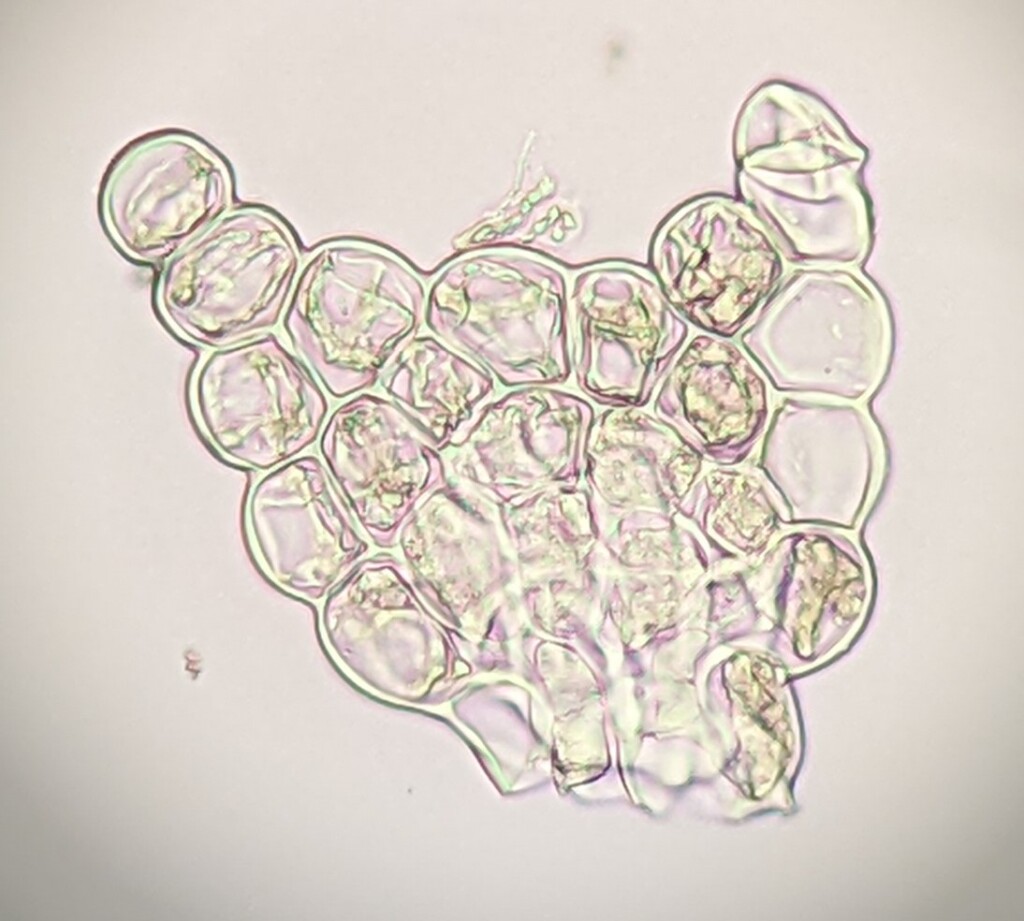
(Grolle) M.A.M.RennerYellow green patches on bark, autoicous. Asexual reproduction rarely by discoid gemmae produced on abaxial lobe surface. Leaves ovate, 275–500 μm long, 125–325 μm wide, angled slightly toward stem apex, acute to acuminate at apex, terminated by a single row of 1–2 cells and curved toward substrate, remote to contiguous, overlapping at most one cell row at the edge of the stem dorsally, stem clearly visible from above, attached to stem by 2 cells; lobe margin crenulate by bulging cells, attached to lobule by bulging keel that seamlessly continues line of lobe margin or lobe margin a curve deviating at an obtuse angle from the keel but without a distinct notch; lobule ellipsoid to fusiform, 150–275 μm long, 80–150 μm wide, inflated, with a single prominent 2-celled tooth usually directed parallel to stem or spreading very slightly away from stem, with hyaline papilla at tooth base; leaf cells rounded polygonal to oblong, 17–33 μm long, 12–25 μm wide, thin-walled, without distinct trigones, smooth. Underleaves divided 1/3–1/2 into two lobes, 85–170 μm long, 70–130 μm wide, not stalked; lobes triangular to lanceolate, directed forward to moderately divergent, separated by an acute to right-angled sinus with a rounded base, 2–4 cells wide at base, terminated by a single row of 1–2 (–3) cells or apex 2 cells wide. Perianth pyriform, 575–875 μm long, 375–575 μm wide, 5-keeled, cells smooth, apex emarginate and with a short cylindric or obconic beak to 30 μm long, sometimes reduced to a pore.
EGL, OtR. In Victoria, this species has been recorded in coastal vegetation on the bark of trees and shrubs such as Melaleuca, Leptospermum, Monotoca and Myoporum, but elsewhere in its distribution it is also known from inland sites from drastically different habitats such as rainforest. Also, Tasmania and New Zealand.
 Spinning