
Lejeunea subelobata
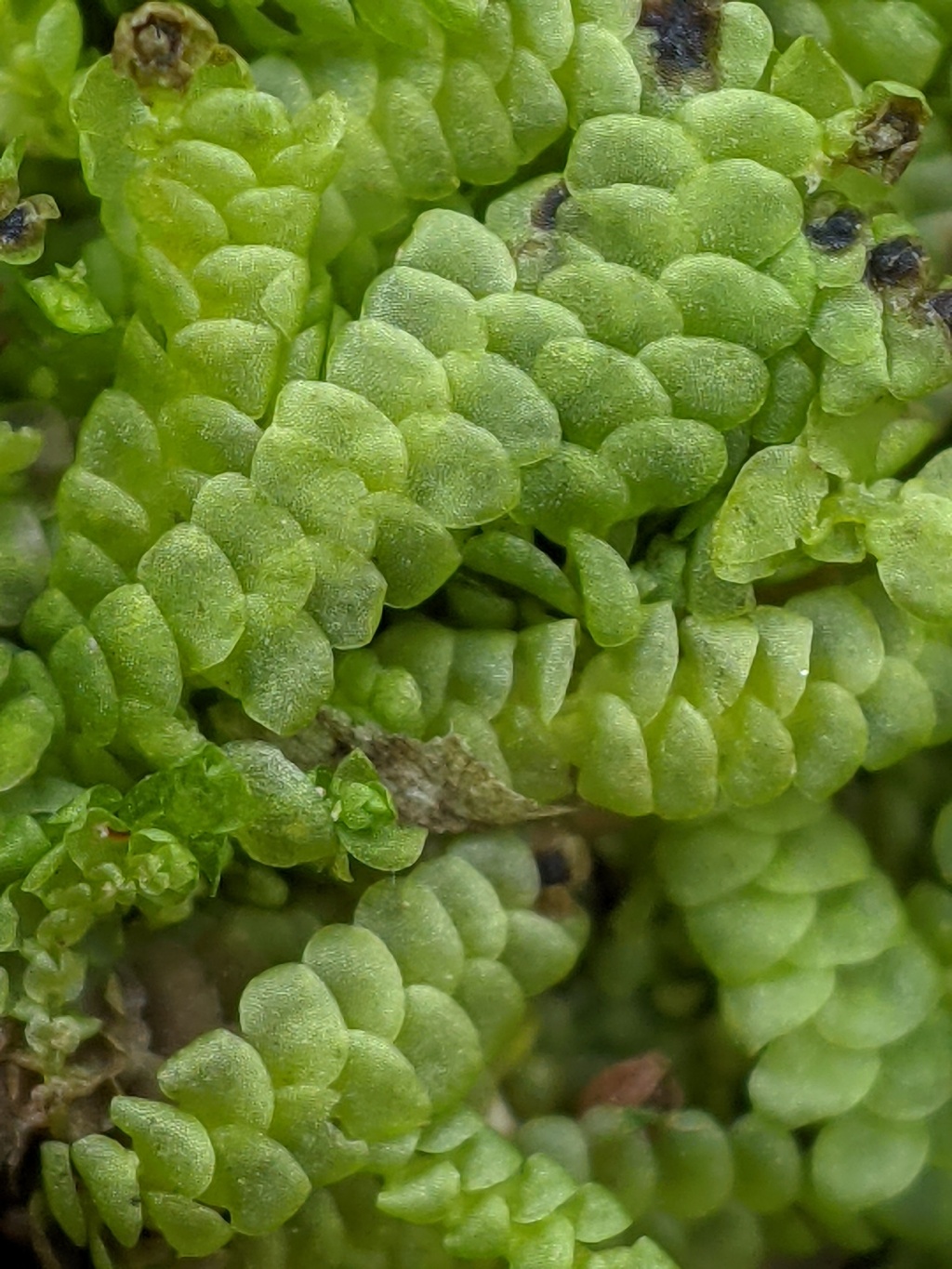
Carrington & PearsonLime green mats on soil, logs and rocks, autoicous. Specialised asexual propagules absent. Leaves broadly ovate, 350–640 μm long, 275–575 μm wide, contiguous to imbricate, rounded at apex, directed slightly in direction of stem apex, minutely crenulate by slightly bulging cells, extending to beyond opposite edge of stem dorsally and completely obscuring stem from above; lobule greatly reduced, usually only the basiscopic margin of leaf near base and one cell wide except for at the single tooth where two cells wide to up to 115 μm long and 3 cells wide not including tooth that is either one of two cells long and directed c. parallel to stem, rarely more well developed and occupying more than the basiscopic abaxial leaf axil, with a straight keel. Leaf cells polygonal, 20–43 μm long, 17–29 μm wide away from margin, smaller at margin where 15–28 μm long and 12–20 μm wide, thin-walled, with small trigones and weak intermediate thickenings, smooth, with more than 30 homogeneous spherical to fusiform oil bodies arranged in submarginal ring. Underleaves orbicular in outline, 160–350 μm long, 150–350 μm wide, remote, with margins near base not extending beyond point of attachment in direction of stem base; lobes 2/5–1/5 of underleaf length, separated by a narrow V-shaped or ligulate sinus, acute or obtuse at apex and acute or rounded at base. Perianth pyriform, distinctly 5-keeled, to 900 μm long, 350–420 μm wide, with a short beak. Underleaf at junction of innovation below perianth oblate-ovate in outline, not or hardly overlapping with bract gyre immediately below perianth.
VVP, VAlp. On soil, rocks and logs beside fast flowing creeks along and south of the Great Dividing Range. Also, New South Wales, Tasmania and New Zealand.
 Spinning