
Zoopsis argentea
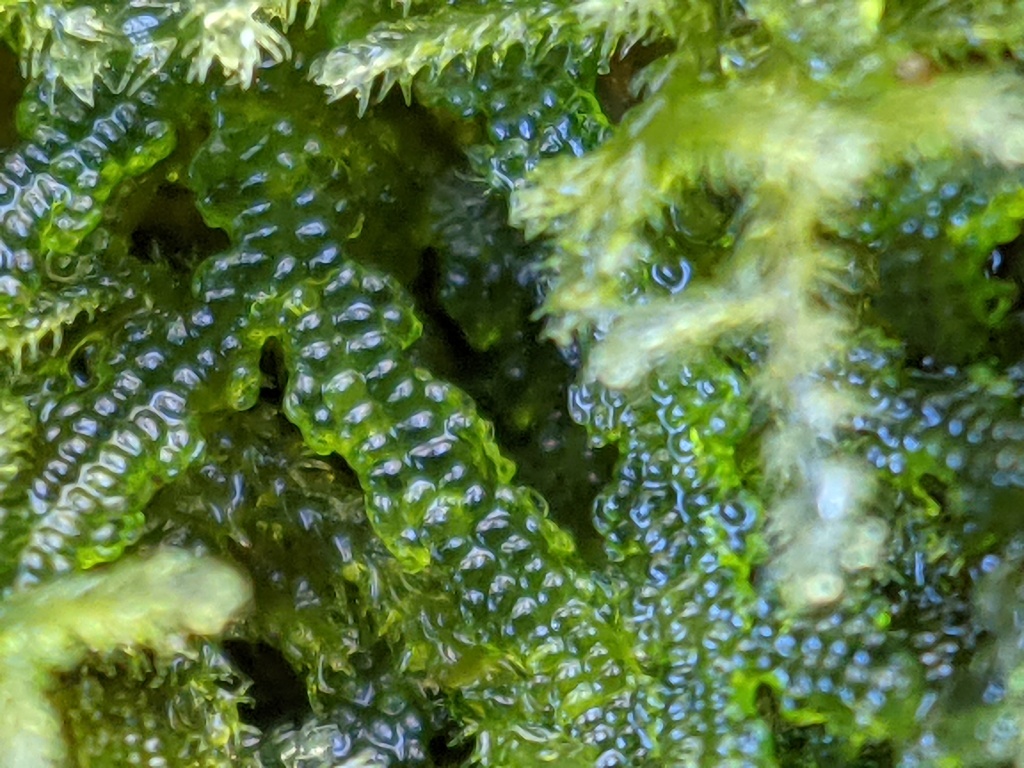
(Hook.f. & Taylor) GottscheEmerald green mats or threads. Specialised asexual propagules absent. Stem dorsiventrally flattened, 2 cell rows wide, 120–440 μm wide. Leaves highly reduced to lateral projections from stem, separated by more than a stem cell, composed of two cells, each bearing at its apex a crescentic hyaline and smooth papilla attached along its length; leaf cells polygonal with bulging hemispheric free margin, 70–150 μm long, 65–165 μm wide, free from each other for 1/6–1/5 of length, thin-walled, without trigones, smooth; papilla on leaf cell closest to stem apex 85–143 μm long, on the other leaf cell smaller, 45–73 μm long; stem cells with (6–) 8–9 (–11) botryoidal oil bodies. Underleaves vestigial, consisting of two inflated cells, each bearing an elongated hyaline cell, sometimes bearing a terminal hyaline papilla. Perianth fusiform to pyriform, to 2000 μm long, to 1000 μm wide, deeply 6-lobed.
GipP, OtP, CVU, EGU, WPro, HSF, HNF, OtR, Strz, MonT, HFE, VAlp. In cool-temperate rainforest and tree fern gullies in wet sclerophyll forest, most frequently on rotting logs in deep shade but also on soil and rocks, in higher rainfall regions of Victoria (the Otway, Dandenong, Yarra and Strzelecki Ranges, Central Highlands, Wilson’s Promontory and Errinundra Plateau). Also, Queensland, New South Wales, Tasmania and New Zealand.
The most common species of Zoopsis in Victoria and a frequent component of bryophyte communities on deeply shaded logs in cool temperate rainforests.
 Spinning