
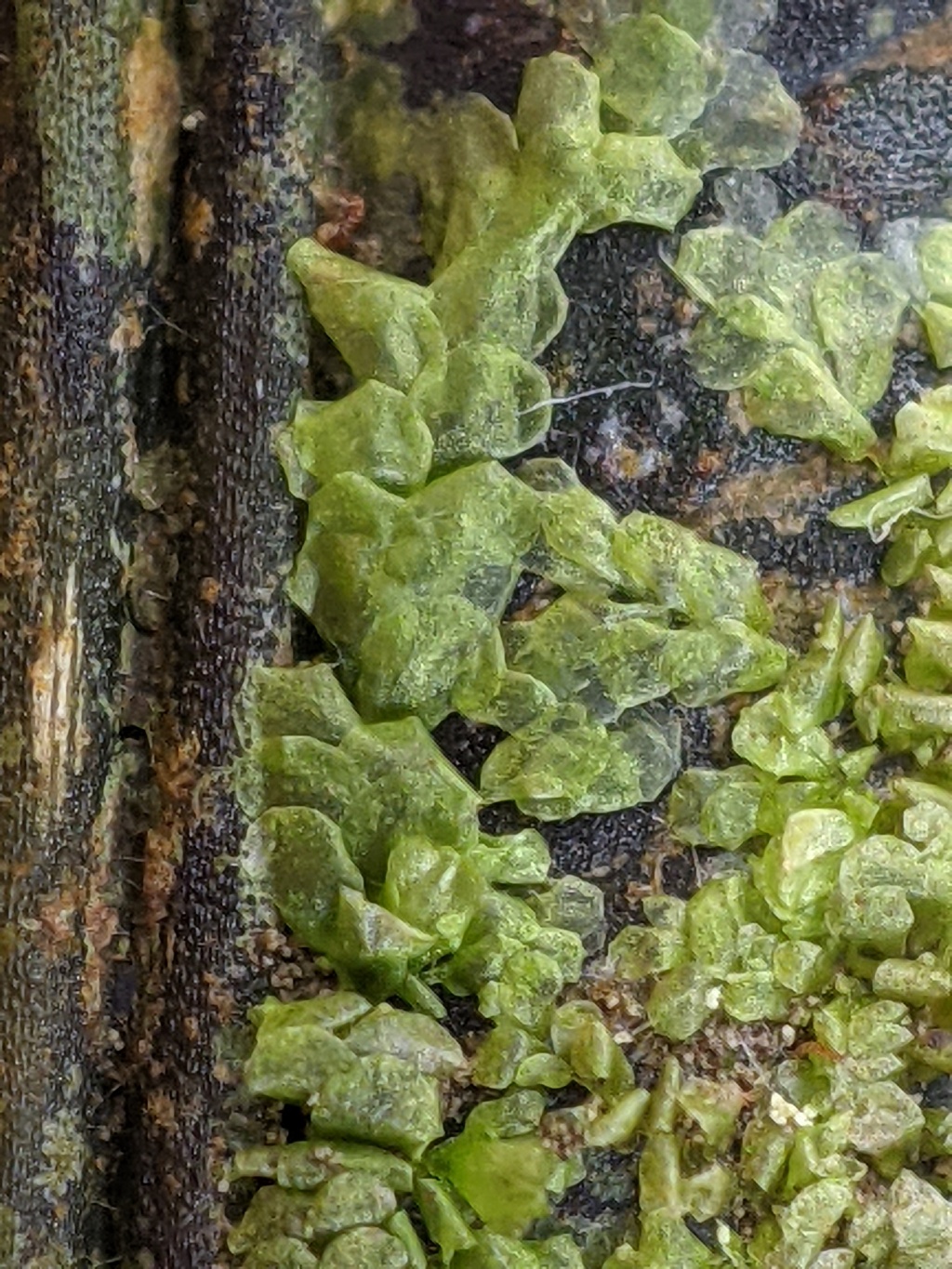
Cololejeunea laevigata
(Mitt.) R.M.Schust.Translucent olive- to yellow-green patches on fern fronds, monoicous. Asexual reproduction by discoid gemmae of up to 16 cells produced on lateral leaf lobe. Leaves panduriform, with widest part in apical half, 500–875 µm long, 300–525 µm wide, imbricate, angled towards apex forming an angle of c. 45° with stem, acroscopic margin often raising off the substrate when moist, with rounded apex, inserted on central row of dorsal stem cells and often free margin extending to beyond opposite edge of stem; lobe margin entire, with minute indents caused by cell corners; lobule truncate-oblong, 280–425 µm long, 155–250 µm wide, not distinctly inflated, with 2–3 teeth positioned on truncate apical section of lobule, directed toward leaf apex, each composed of non-elongated cells and 1–3 cells long, the basal tier often 2 cells wide, the tooth furthest from stem with a hyaline papilla at base on side facing stem and other lobule teeth, with a curving keel that is symmetric with the curve of the opposing acroscopic lobe margin and ending at narrowest point of leaf. Leaf cells rectangular, oblong or quadrate, those in marginal few rows smallest, 7–28 µm long and 5–10 µm wide, becoming longer towards leaf midline where 17–53 µm long and 8–25 µm wide, the longest near basal centre, thick-walled, with intermediate thickenings, with distinct trigones, smooth. Perianth pyriform, 625–850 µm long, 375–525 µm wide, 5-keeled, emarginate at apex, with a short beak, with smooth cells.
OtP, OtR. In Victoria recorded from Nothofagus cunninghamii dominated cool-temperate rainforest of the Otways where it grows on the fronds of Blechnum ferns. Also, Tasmania, Lord Howe Island, and New Zealand.
 Spinning