
Cephaloziella varians
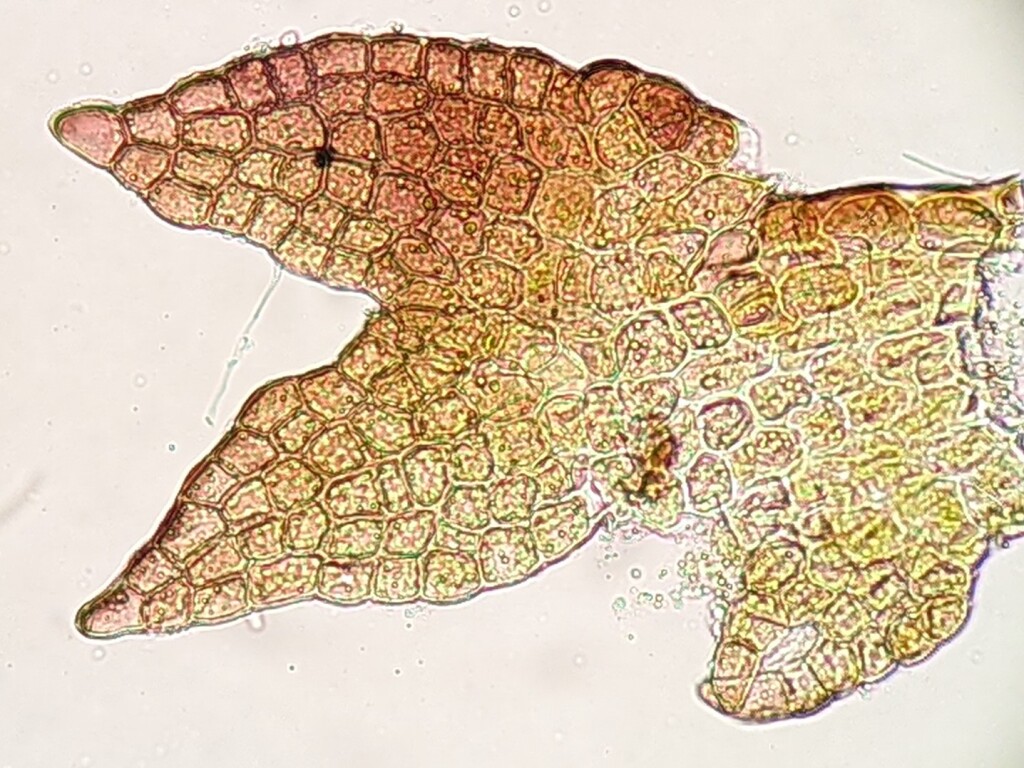
(Gottsche) Steph.Creeping to suberect on soil, brownish green to purplish brown or purplish black, autoecious. Asexual reproduction by 2-celled gemmae with or without a weak projection at each end. Stems 5–8 cells wide; branches emerging laterally and not associated with modified leaves. Leaves subquadrate or short-oblong in outline, bilobed for 0.5–0.7 of length, 170–250 µm long, 170–250 µm wide, erect to erect-spreading, remote, entire; lobes 6–12 (–14) cells wide at base, weakly divergent. Underleaves lingulate to lanceolate or bilobed, 3–6 cells long, 2–4 cells wide. Leaf cells subquadrate to oblong, 10–25 (–40) µm long, 10–18 (–23) µm wide, smooth, thin- to thick-walled, without trigones; oil bodies 2–7 per cell, homogenous. Androecia terminal, becoming intercalary, with 4–10 pairs of ventricose bracts. Female bracts similar to vegetative leaves except sometimes finely and remotely denticulate; bracteole 2- or irregularly 3- or more lobed, fused for 0.1–0.3 of its length with bracts. Perianth obolid to clavate, greenish with a bleached mouth, with crenulate mouth.
LoM, VVP, Gold, GGr, EGU, HNF, VAlp. Mostly on soil in open sites in the drier regions of northern and western Victoria, but occasionally also in open sites in wetter regions. Throughout Australia, New Zealand and in temperate to polar regions of both hemispheres. The only species of liverwort that occurs on continental Antarctica (Bednarek-Ochyra et al. 2000).
Bednarek-Ochyra, H., Váňa, J., Ochyra, R., Lewis Smith, R.I. (2000). The Liverwort Flora of Antarctica. Polish Academy of Sciences: Cracow.
Engel, J.J. & Glenny, D. (2008). A Flora of the Liverworts and Hornworts of New Zealand. Volume 1. Missouri Botanical Garden Press: St Louis.
 Spinning