
Pseudomarsupidium piliferum
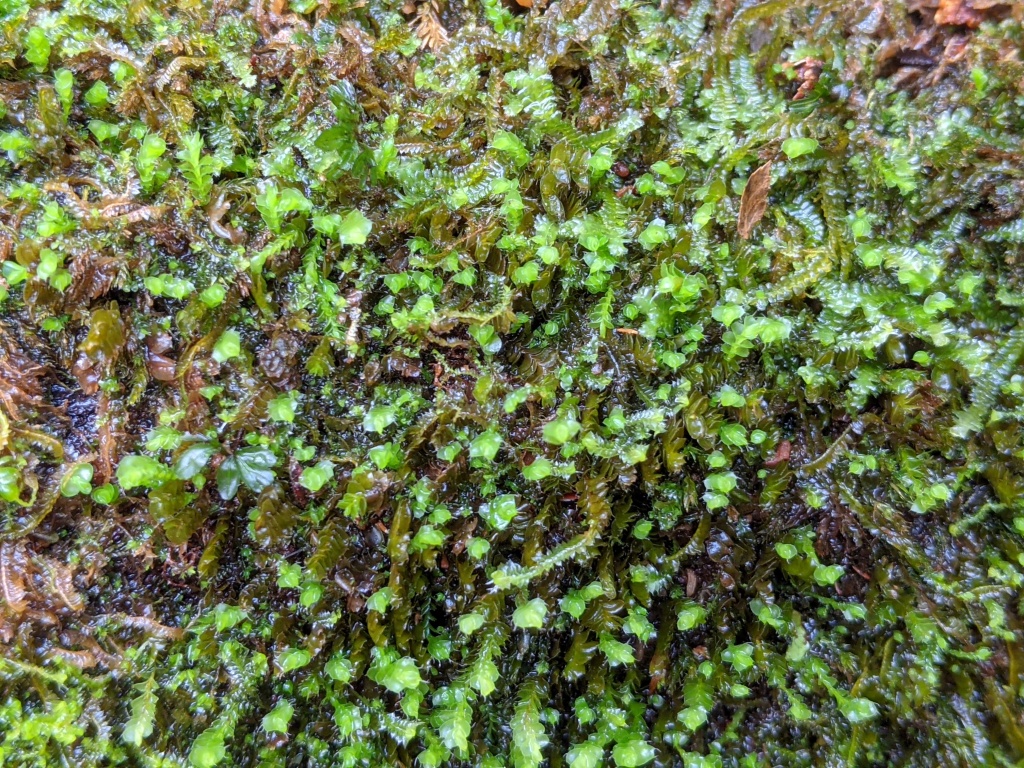
(Steph.) Herzog ex GrollePlants bright green, aging to yellow- or brown-green. Branches emerging from ventral side of stem. Leaves reniform or ovate to orbicular in outline, scale like and entire on lower stem, increasing in size toward apex, in apical half of stem 1–2.43 mm long (excluding setae), 0.97–2.2 mm wide and with two elongate hyaline or pale brown setae that are typically flexed ventrally, otherwise entire, concave adaxially, often incurved along basiscopic margin and broadly decurrent; photosynthetic leaf cells polygonal and mostly isodiametric, 17–63 μm long, 15–50 μm wide, smallest near margin, thin- or firm-walled, except at margin where marginal wall markedly thicker and with larger trigone, with 10–19 oil bodies in cells in mid-region; oil bodies greyish, spherical to ellipsoid, coarsely papillose, botryoidal; setae composed of a single series of up to 12 cells, to 0.5 mm long, sharply pointed at apex; seta cells quadrate at base, becoming elongated, 27–114 μm long, 17–45 μm wide, with thick-walls. Bracts in 2–3 (–4) series, dentate, becoming lobulate and ciliate toward apex in bracts of inner series, free or innermost series fused to each other and to bracteole at base or for majority of length forming a distinct perianth. Bracteoles almost equivalent to bracts or much smaller. Perianth when most optimally formed, ovoid-cylindric, sometimes distinctly trigonous. Calyptra extending to perianth mouth when well-developed or otherwise beyond. Capsules ellipsoid, 4–5-stratose.
GGr, EGL, HSF, OtR, HFE. Rare in Victoria, where known from moist rock crevices of outcrops of the higher peaks of the Grampians and Mount Ellery in East Gippsland, on Nothofagus cunninghamii in cool-temperate rainforest of the Otways, and from Genoa Gorge. Also, New South Wales, Tasmania, New Caledonia, New Zealand, southern Chile, Juan Fernandez, Inaccessible Island and Nightingale Island.
The two apical setae on the leaves of this species are highly distinctive, usually large and easily visible in the field, and allows this species to be distinguished from other Victorian liverworts.
 Spinning