
Cephaloziella hirta
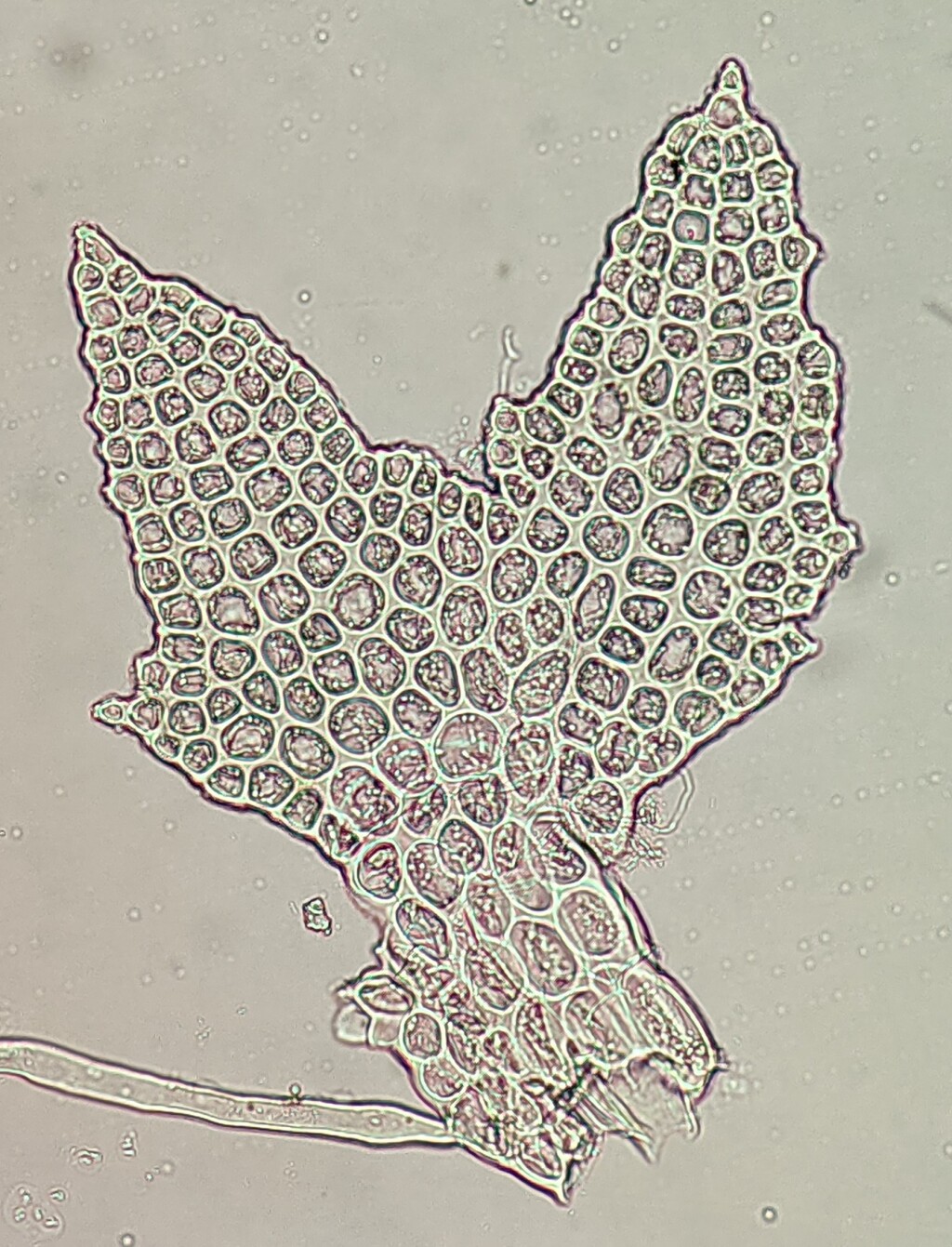
(Steph.) R.M.Schust.Creeping on burnt wood or bark, green, dioicous. Asexual propagules present, 2-celled, elliptic to subquadrate, with hemispherical papillae. Stems 4–5 cells wide, often with spinose protuberances; branches emerging from stems laterally and ventrally and not associated with reduced leaves. Leaves subquadrate to obtrapezoidal in outline, 60–200 µm long, 100–220 µm wide, bilobed for 2/3–3/4 of its length, wide-spreading at base, becoming flexed toward apex, remote to imbricate, spinose along entire margin, sometimes also on abaxial surface; lobes 4–8 cells wide at base, moderately divergent. Underleaves present, lanceolate or asymmetrically bilobed, 40–65 µm long, 25–50 µm wide; cells rounded quadrate to oblong, 7–20 µm long, 7–15 µm wide, smallest near margins, firm-walled, without distinct trigones, conspicuously papillose. Female bracts closest to perianth bilobed for c. ½ of its length, with triangular and spinose lobes; bracteole oblong in outline, bifid for c. 1/3 of its length, fused for 2/3 of its length with both bracts, with triangular and spinose lobes. Perianth decolorate or greenish with a bleached mouth, 3–5-plicate in apical half, with minutely denticulate mouth.
Wim, OtP, Gold, CVU, EGL, WPro, HSF, HNF, MonT, HFE, VAlp. In sclerophyll forests throughout Victoria and in alpine areas, often opportunistically colonising burnt stumps and logs. Also, Queensland, New South Wales, Australian Capital Territory and Tasmania.
 Spinning