
Acrobolbus surculosus
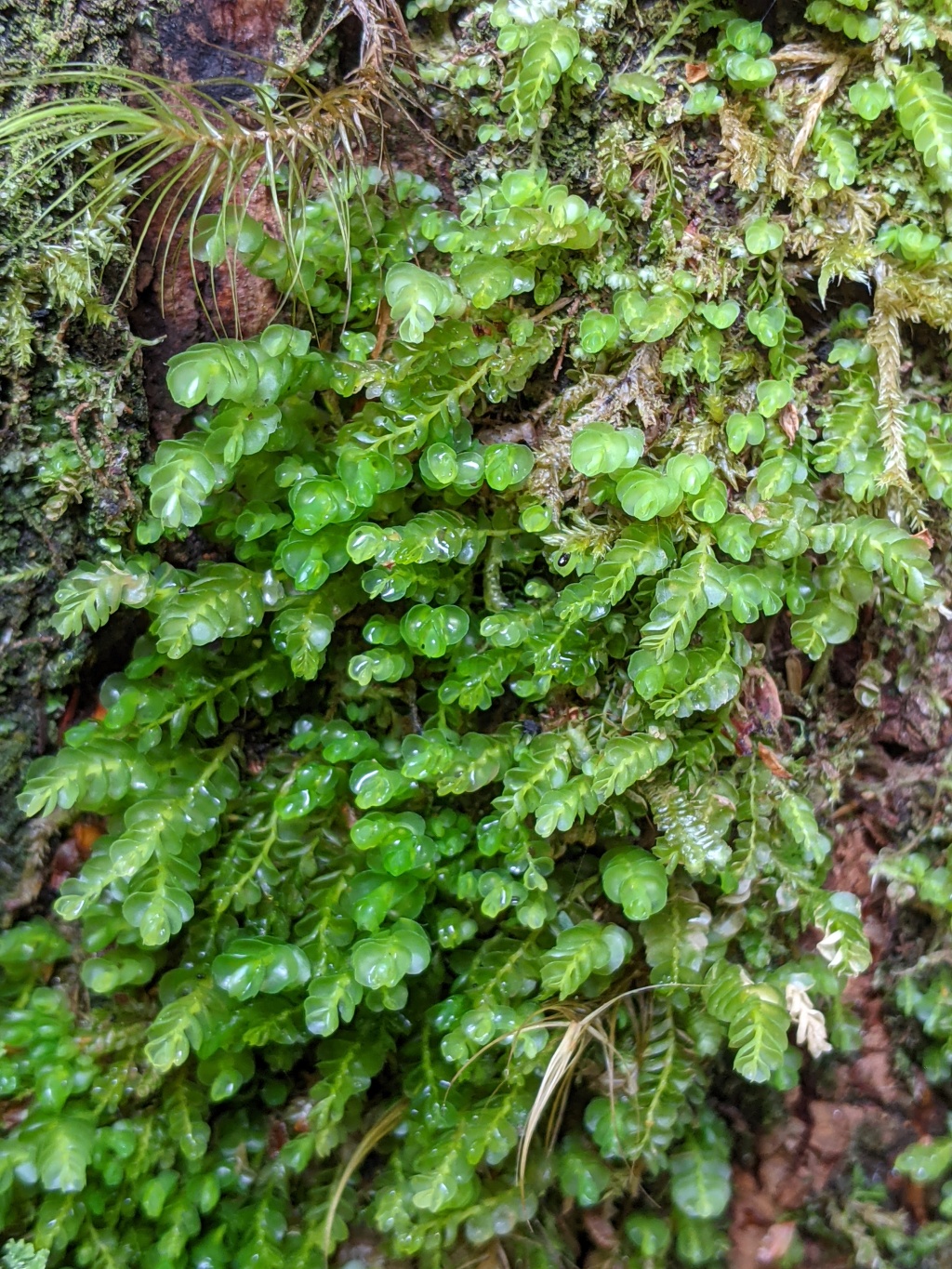
(Nees) TrevisPlants pale green. Stems differentiated into creeping stolons and erect leafy shoots; branches arising laterally from stems and without an associated narrowed leaf or arising ventrally from basal portion of leafy stem or stolon, smooth, largest leaves toward apex and not flagelliform. Specialised asexual propagules absent. Rhizoids hyaline, scattered along stolons and basal of erect leafy shoots. Leaves oblate to reniform in outline, retuse, shallowly bilobed or sometimes entire, 975–2625 μm long, 1075–3500 μm wide, widely spreading and oriented to be facing toward stem apex, margins curved upwards giving leaf a saucer-like concavity adaxially; lobes when present unequal, often ventral broadly rounded and dorsal narrower and acute or apiculate and terminating in a single row of up to 3 cells, or sometimes both acute or apiculate, when acute or apiculate usually directed ventrally and then the leaf resembling a circular saw. Underleaves vestigial, consisting of a cluster of cells and numerous slime papillae. Leaf cells polygonal, 27–58 μm long, 22–35 μm wide, thin-walled, with small trigones, smooth, usually with 2–4 oil bodies in leaf centre; oil bodies ovoid, ellipsoid or reniform, greyish to pale yellow brown, coarsely granular to papillose. Gynoecia on abbreviated branches. Capsules bullet-shaped, 5–6-stratose. Elaters bispiral. Spores densely covered in short cylindric to mesa-like protrusions.
CVU, EGU, WPro, HSF, HNF, OtR, HFE, VAlp. On rocks, logs and trees in rainforest and wet sclerophyll forest throughout Victoria. Also, Queensland, New South Wales, Australian Capital Territory, Tasmania and New Zealand.
 Spinning