
Marsupella sparsifolia
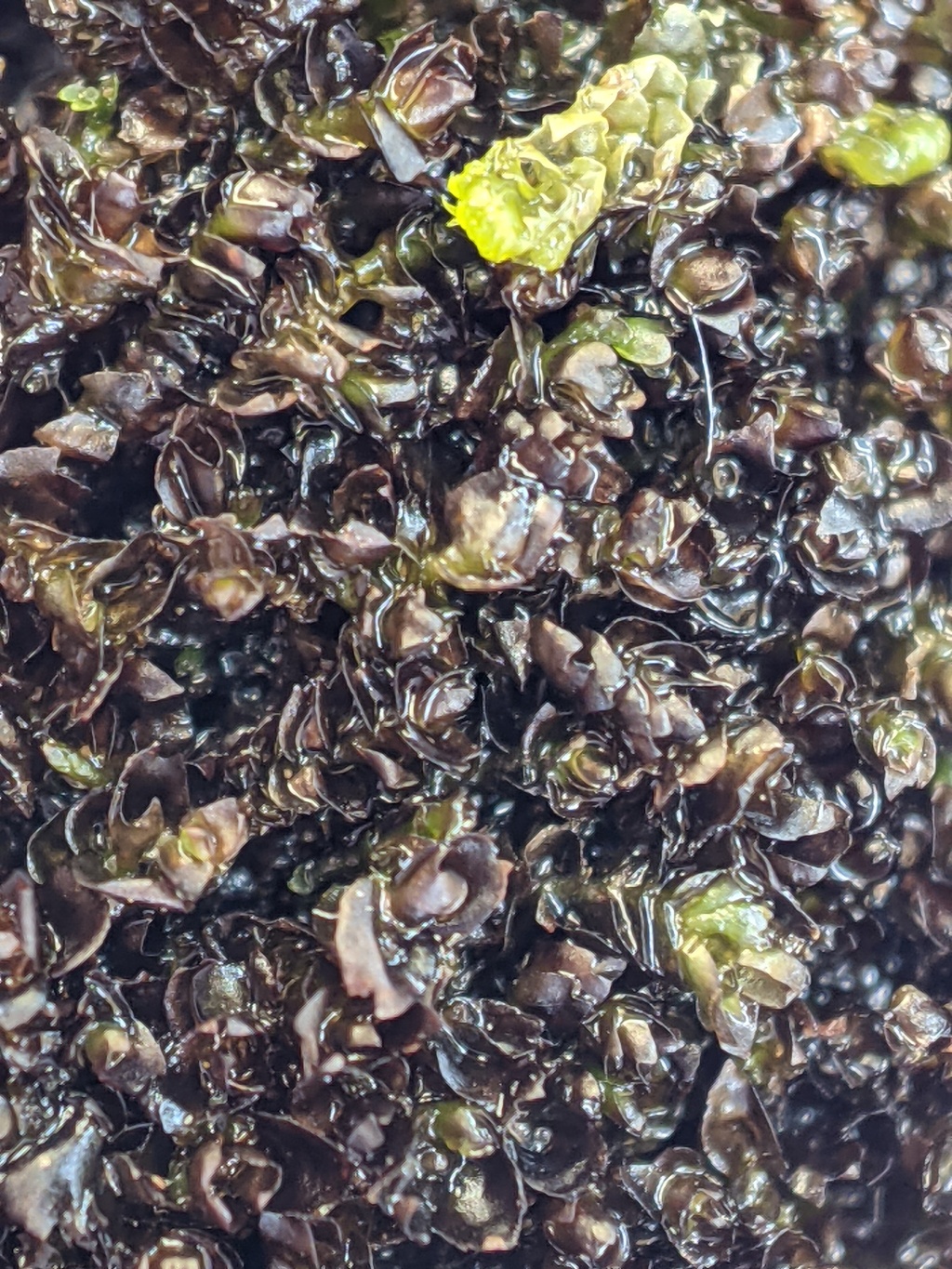
(Lindb.) Dumort.Stems erect, dark brown to black. Leaves ovate to elliptic in outline, bilobed, 350–850 μm long, 325–800 μm wide, concave adaxially, wide spreading; lobes 0.15–0.25 the length of the entire leaf, one often slightly larger than the other, obtuse to acute. Leaf cells circular, elliptic or rounded quadrate, 7–23 μm long, 7–18 μm wide, becoming larger near base and 400–620 μm long, 360–520 μm wide, smooth, with prominent trigones, usually with 2 large oil bodies, often 3–4 near base; oil bodies whitish, globose to ellipsoid, finely papillose. Androecial bracts abruptly larger that surrounding vegetative leaves, in 2–3 pairs, each with 2 antheridia. Bracts below perianth similar to vegetative leaves but larger and less divided. Bracteoles absent. Perianth truncate-ovoid, not exceeding bracts, with crenulate mouth. Eaters bispiral. Spores vermiculate.
VAlp. Rarely recorded from rocks on Mount Bogong and the Bogong High Plains. Also, New South Wales, Tasmania and cold-temperate regions of both hemispheres.
Australian and New Zealand populations have been recognised as the subspecies childii.
This species is very similar to Andrewsianthus perigonialis and is difficult to distinguish from it when not fertile, which is usually the case. The leaf cells of Marsupella sparsifolia are firm-walled, dark reddish-brown and of a consistent thickness throughout and almost all cells away from the base have two oil bodies, whereas in A. perigonialis the cell walls are orange to yellow-green and more variable in thickenss because the trigones are less uniform in size and often become confluent, and the number of oil bodies varies more between cells, usually between two and five.
 Spinning