
Cephaloziella exiliflora
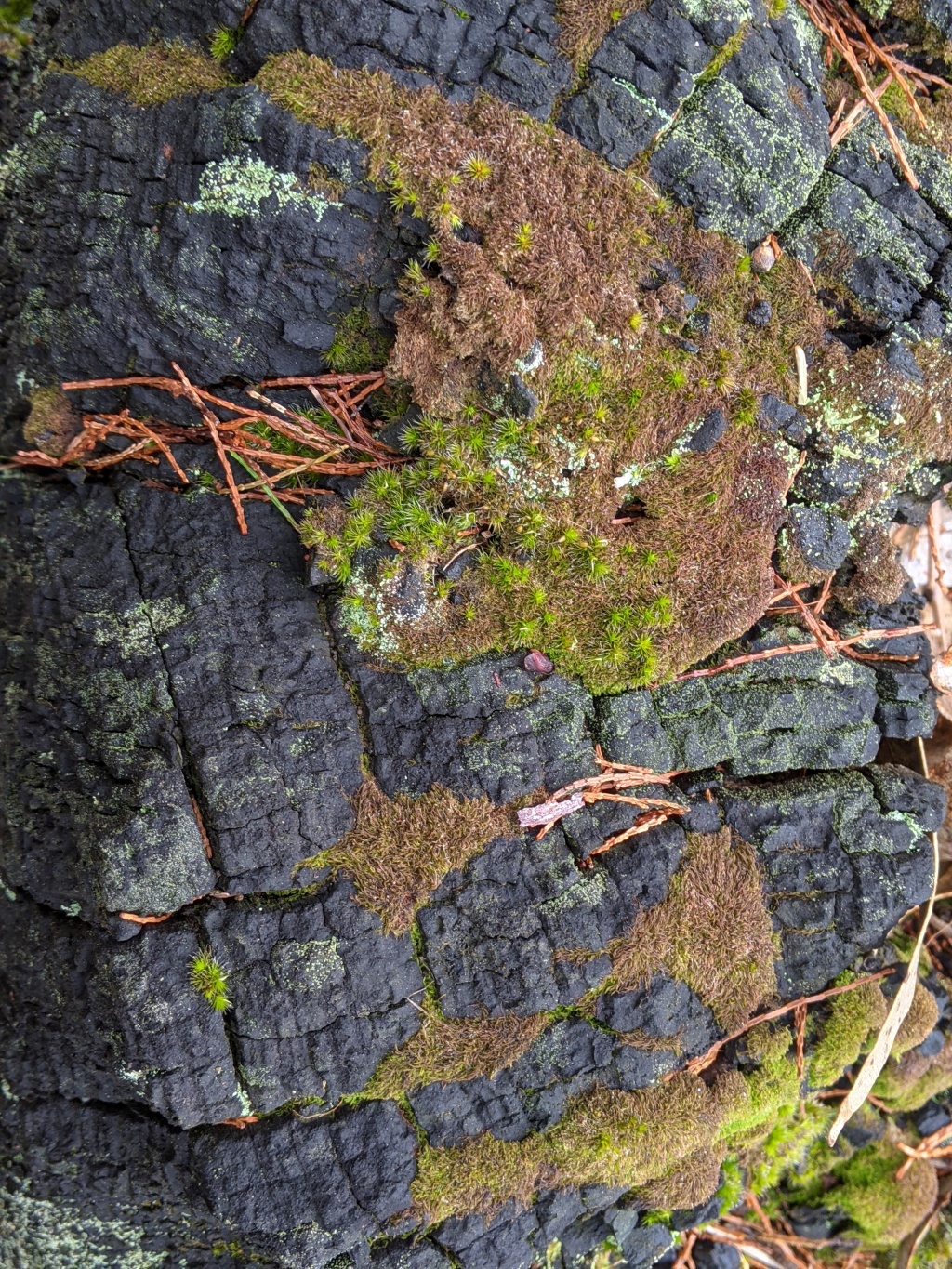
(Taylor) R.M.Schust.Turves most frequently on burnt wood, pale or whitish prostrate shoots becoming light green to reddish brown or purplish brown toward erect growing apices, pseudodioicous. Specialised asexual propagules absent. Stems 3–4 cells wide. Leaves subquadrate to obtrapezoidal in outline, bilobed for 0.5–0.6 of its length, 140–250 µm long, 140–275 µm wide, erect-spreading, remote, entire or slightly denticulate; lobes (4–) 6–7 cells wide at base, 9–12 cells wide at base near gynoecia, weakly to moderately divergent. Underleaves triangular to quadrate, 50–65 µm long, 45–55 µm wide, becoming larger and bilobed near gynoecia. Leaf cells rounded quadrate to oblong, 7–20 µm long, 7–18 µm wide, smooth, firm-walled, without or with small trigones. Androecia terminal, with 6–10 pairs of ventricose bilobed bracts. Female bracts closest to perianth bilobed for c. 0. 4 of its length, with triangular and denticulate lobes; bracteole oblong in outline, bifid for c. 0.4–0.45 of its length, fused for 0.35–0.5 (–0.6) of its length with one or both bracts. Perianth decolorate of greenish with a bleached mouth, 4–5-plicate in apical half, with crenulate mouth.
Wim, VVP, VRiv, GipP, OtP, Gold, CVU, GGr, NIS, EGL, EGU, WPro, HSF, HNF, OtR, HFE, VAlp.
Widespread throughout sclerophyll forests, where usually opportunistically colonising burnt stumps and logs. Also, all other states and territories and New Zealand.
Engel, J.J. & Glenny, D. (2008). A Flora of the Liverworts and Hornworts of New Zealand. Volume 1. Missouri Botanical Garden Press: St Louis.
 Spinning