
Balantiopsis tumida
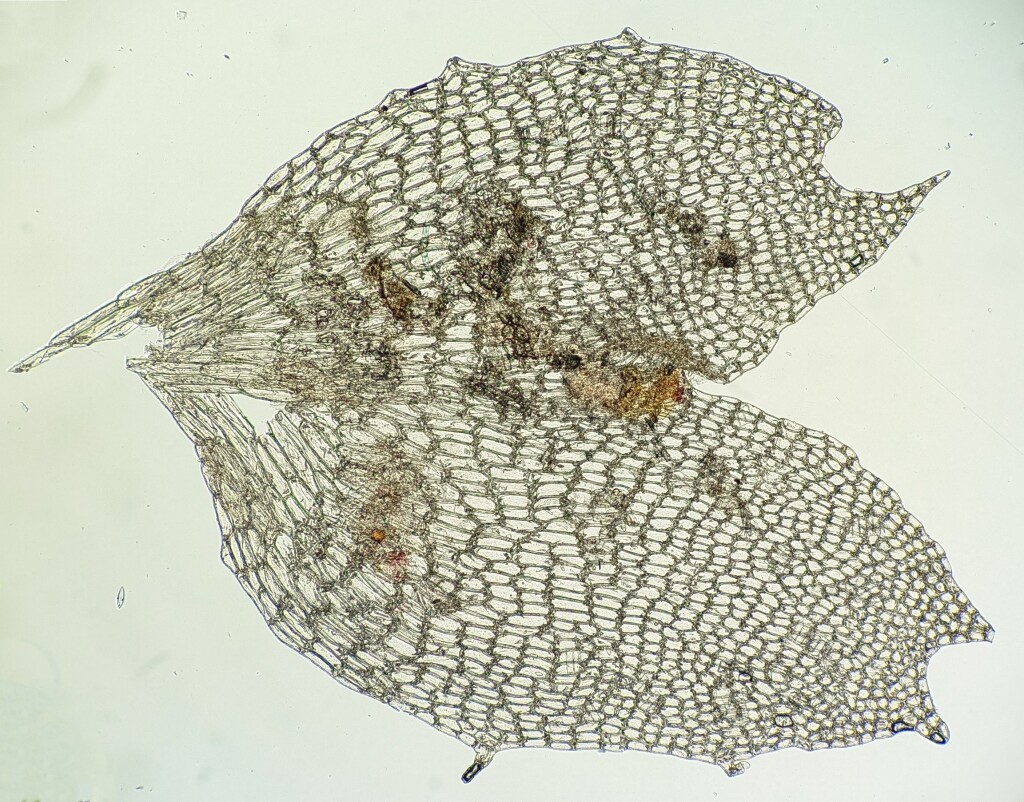
Berggr.Tufts, green to wine red. Stems ascending to erect, with occasional branches; branches mostly emerging from stem laterally and associated with a leaf without a ventral lobe, sometimes emerging ventrally from stem and not associated with a reduced underleaf. Leaves imbricate, obliquely spreading from stem, the ventral lobe along acroscopic margin curving away from stem, making ventral lobe concave in ventral view, sometimes becoming folded, both dorsal and ventral lobes attached to stem with a broad inverted U-shaped insertion; ventral lobe elliptic to broadly elliptic, with two lobes to 225 μm long, 1575–2375 μm long, 900–1625 μm wide, entire or with up to 4 cilia-like teeth to 4 cells long along acroscopic margin, attached to dorsal lobe by a straight keel 375–950 μm long; dorsal lobe broadly ovate to orbicular, with 2 or 3 lobes to 425 μm long, 1250–2100 μm long, 850–1800 μm wide, crenate or with up to 3 teeth, occasionally one cilia-like to 2 cells long. Underleaves broadly ovate to orbicular in outline, bilobed to 1/3 of the underleaf length, 1175–1800 μm long (not including decurrencies), 1000–1900 μm wide, with 2–4 teeth, sometimes larger teeth ciliate, imbricate; lobes broadly triangular, entire or with a single tooth. Leaf cells polygonal to oblong, in apical parts of leaf lobes 30–70 μm long and 17–30 μm wide, becoming more elongate to 95 μm long toward base, firm-walled and evenly thickened throughout, smooth to minutely striolate-papillose, with 2–5 oil bodies; oil bodies ovoid, spherical, fusiform or ellipsoid, hyaline to smoky grey, granular.
GGr, EGU, VAlp. Associated with silt banks of creeks and bogs of the alpine zone of the Victorian Alps, and often submerged. Also, New South Wales, Tasmania and New Zealand.
This species in Victoria has been distinguished from other Balantiopsis based on the absence of marginal cilia on its leaf lobes, its less divided underleaves, and its aquatic alpine habitat (Scott 1985). The aquatic habitat is quite different to the usual habitats of road embankments that B. diplophylla occupies in Victoria, and matches the habitat of plants assigned to this species in New Zealand (Engel & Glenny 2019). However, plants in New Zealand, where the type is from, differ from Victorian plants in often having smaller cells, sinuose-thickened cell walls and walls between marginal cells bulging at the margin to form a minutely denticulate margin (Engel & Glenny 2019) and so the species identity of the Victorian plants described here requires confirmation through comparison of DNA sequences. The morphological features used to distinguish this species from B. diplophylla in Victoria also exhibits large variation obliterating clear cohesion of distinct morphological groupings. Consequently, species limits in the genus would benefit from a critical re-evaluation utilising analyses of DNA sequences. It is possible that these plants merely represent an aquatic alpine form of B. diplophylla.
Engel, J.J. & Glenny, D. (2019). A Flora of the Liverworts and Hornworts of New Zealand. Volume 3. Missouri Botanical Garden Press: St Louis.
 Spinning