
Goebelobryum unguiculatum
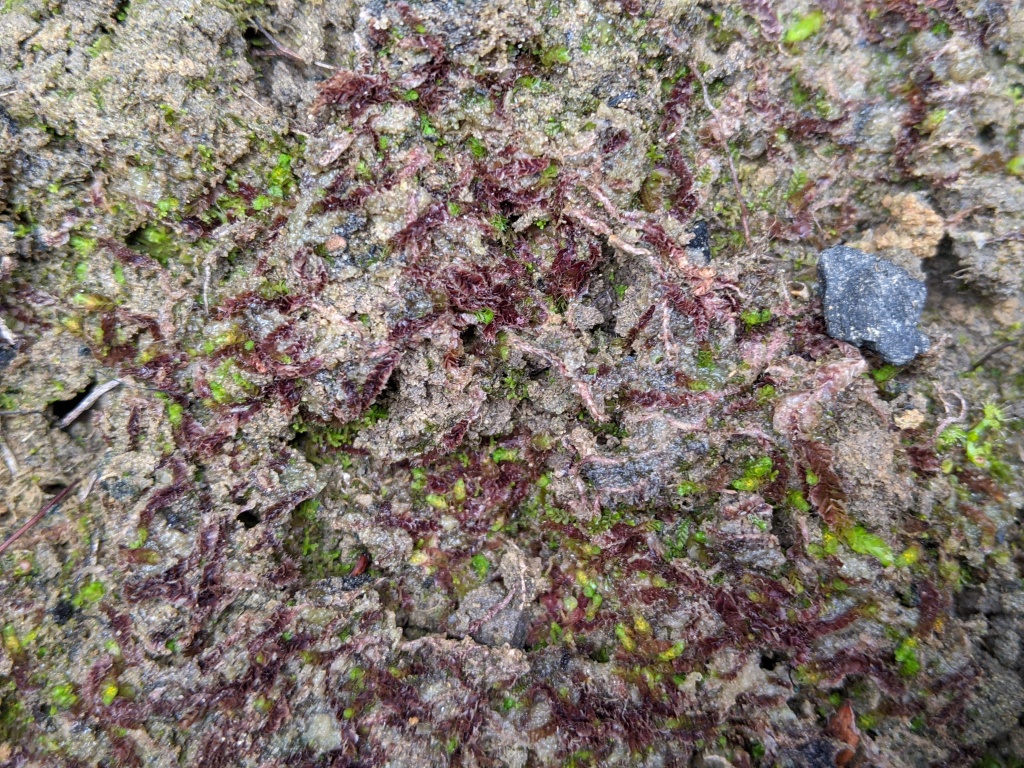
(Hook.f. & Taylor) GrollePlants yellow green to burgundy. Stems creeping, sometimes slightly immersed into substrate; branches emerging from stem laterally and not associated with a narrower leaf. Rhizoids in fascicles from near the ventral base of leaf and at underleaf bases or scattered along stem. Leaves ovate to oblate in outline, asymmetrically bilobed, emarginate or simple, excluding setae 875–2750 μm long, 850–4125 μm wide, widely spreading and oriented with surface in same plane as substrate, ventral margin extending to near stem midline but not overlapping with opposing leaf and ventral stem clearly visible, with seta usually scattered along margins formed by a single row of up to 6 cells, rarely few and confined to ventral margin; lobes rounded, usually with setae, rarely entire, often ventral larger than dorsal. Underleaves small, to 5 cells wide, free or connate with adjacent lateral leaf, with two to four teeth. Leaf cells polygonal, 27–100 (–118) μm long, 20–68 μm wide, without a distinct field of more elongated cells near basal centre, but elongate and rectangular in setae and 35–123 μm long, 15–58 μm wide (excluding smaller terminal cell), thin-walled with distinct trigones, except for in setae where thick-walled, smooth, usually with 2– 4 oil bodies in cells of leaf centre; oil bodies ellipsoid to spherical, orange to chocolate brown, granular. Androecia with 7– 8 pairs of bracts more strongly oriented dorsally than vegetative leaves, each with 3–5 antheridia. Gynoecia terminal on leading shoots; bracts much larger than vegetative leaves but otherwise similar.
GleP, VVP, GipP, OtP, GGr, DunT, EGL, WPro, VAlp. Sporadically distributed throughout southern Victoria in woodland with a heathy understorey or in heathy swamps from sea level to the subalpine zone. Also, Western Australia, Queensland, New South Wales, Tasmania, New Zealand and New Caledonia. .
A highly distinctive species unlikely to be mistaken for any other species. Perhaps the most similar species owing to its setose-margined leaves is Chaetophyllopsis whiteleggei, however, this species has large underleaves, the leaves are usually highly crispate and their marginal setae are always unicellular.
 Spinning