
Cheilolejeunea mimosa
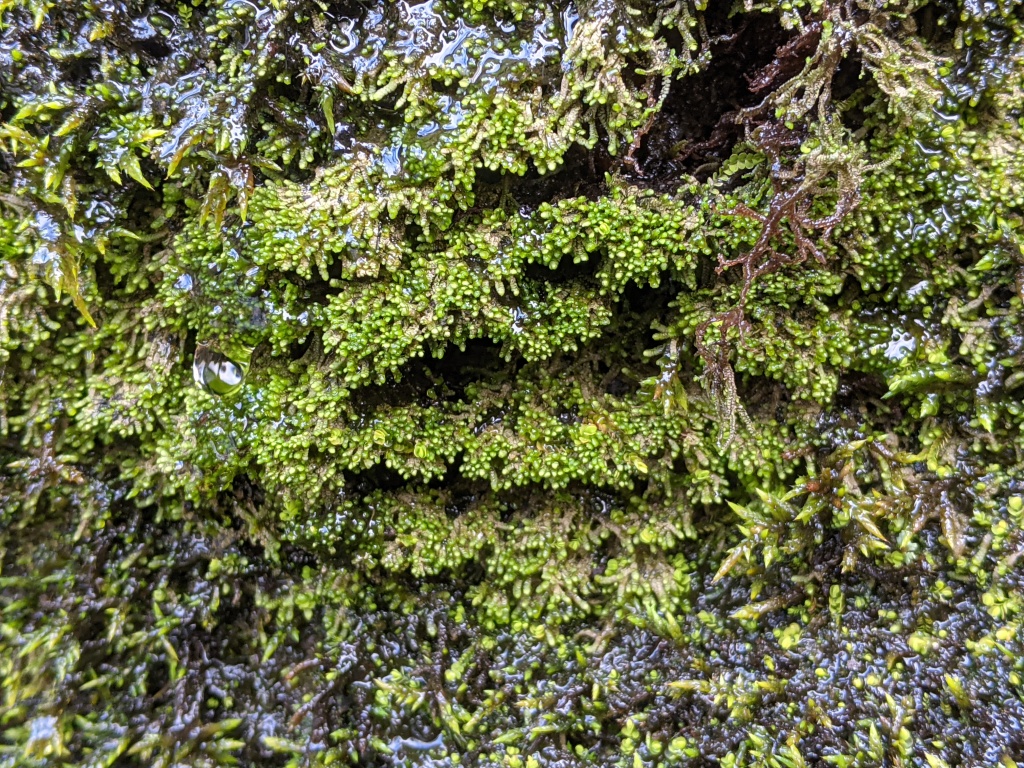
(Hook.f. & Taylor) R.M.Schust.Yellow-green to olive-green mats, forming shelves on vertical substrates, dioicous. Specialised asexual propagules absent. Leaves spreading from the stem so that they are angled slightly in direction of stem apex, 425–850 μm long, 450–725 μm wide, imbricate, free acroscopic margin of the lobe extending beyond the opposite edge of stem dorsally and obscuring the stem from above; lobe elliptic to ovate, rounded to obtuse and often curved downwards toward substrate at apex, entire, margin curving outwards and often below level where attached to keel, forming a distinct notch; lobule ovoid, 160–210 μm long, 175–200 μm wide, with a single well-developed acutely pointed tooth directed away from stem and comprising 1–2 non-elongated cells, the free margin basally bulging away from curve of keel and toward apex curve parallel to outwardly bulging curve of keel up to tooth. Leaf cells rounded quadrate to oblong or rectangular, becoming just rounded quadrate at margin, 15–33 μm long and 15–20 μm wide away from margin, 8–20 μm long and 8–14 μm wide at margin, thin-walled, with large prominent trigones, often becoming confluent, smooth, with 2–3 botryoid oil bodies. Underleaves orbicular, broadly obovate, broadly ovate or broadly oblong in outline, 225–375 μm long, 225–375 μm wide, with two lobes 1/4–1/3 length of underleaf, with a weakly arched insertion line, entire; lobes separated by a linear to V-shaped sinus with an acute or rounded base, straight edged along sinus and outwardly curved on exterior margin. Perianth obovoid, 875–1200 μm long, 500–675 μm wide, 5-keeled, with a short apical beak 1–2 non-elongated cells long, shoots continuing on from below perianth bearing a lateral leaf lower on the shoot than the first underleaf.
GipP, OtP, GGr, EGL, EGU, WPro, HSF, HNF, OtR, HFE. A reasonably common and widespread species in Victoria occurring along and south of the Great Dividing Range in a wide range of moist habitats including on rocks on the banks of fast flowing creeks and around waterfalls and on rocks, tree trunks and on fern fronds in wet sclerophyll forest and rainforest. Also, Queensland, New South Wales, Australian Capital Territory, Tasmania and New Zealand.
 Spinning