
Cuspidatula monodon
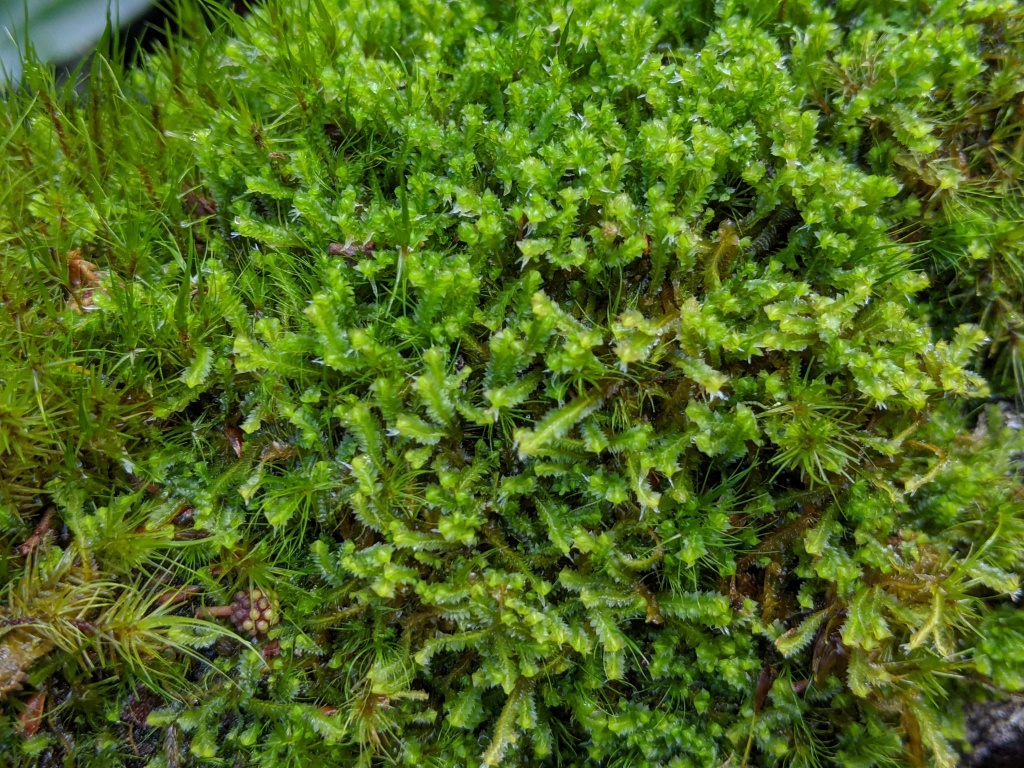
(Taylor) Steph.Greenish brown, golden brown, purplish brown or reddish. Epiphytic or lithophytic. Stems prostrate, with the tips ascending; branches emerging from the ventral side of the stem or emerging laterally without a collar of tissue at base but also closest leaf not noticeable half width. Leaves ovate to ovate-lanceolate, 700–1650 µm long, 500–1100 µm wide, becoming longer toward stem apices, with an acute, short-acuminate or piliferous apex ending in a uniseriate row to 15 cells long and often appearing hyaline, widely spreading or strongly directed dorsally, entire or with a single tooth on acroscopic margin. Underleaves absent or vestigial and composed of 1–4 cells, the terminal cells with a slime papilla. Leaf cells hexagonal, circular, elliptic or oblong, 12–25 µm long and 20–24 µm wide near margins and apex, larger and more elongate near basal centre, 20–55 µm long and 15–38 µm wide, smooth or striate-papillose, thin-walled with large nodose and often confluent trigones, becoming thick-walled near margins, with 3–10 ellipsoid to spherical oil bodies. Bracts below perianth deeply concave, innermost pair both bilobed or often differing in lobe number with one bilobed and the other 3–4-lobed, the lobes 2/5–2/3 the length of the bract, entire or with spinose teeth or accessory lobules. Bracteoles oblong-lanceolate, unlobed, usually shorter than bracts, free or narrowly connate to one bract, usually laciniate in apical half. Perianth lobulate and with stiff piliferous cilia at mouth.
OtP, EGL, EGU, WPro, HSF, OtR. Epiphytic and on fallen branches in rainforest in the Otways, Yarra Ranges and Gippsland, and occasionally lithophytic on coastal peaks that are often shrouded by cloud. Also, Queensland, New South Wales, Tasmania and New Zealand.
 Spinning