
Chaetophyllopsis whiteleggei
(Carrington & Pearson) R.M.Schust. ex HamlinProstrate, light green to grey-green, subclavate shoots. Leaves with widely-spreading disc, with lobes stiffly angled toward apex, with 3 or 4 main lobes, 225–1430 μm long, 350–2500 μm wide, with reflexed margins; lobes 0.5–0.65 of total leaf length, usually each with additional triangular crispate lobules, abaxially sulcate. Underleaves when smaller with a main central lobe and two lateral smaller lobes, themselves often with additional lobules, or when larger toward stem apex with two main lobes to 2/5–3/4 of underleaf length, with 1–2 smaller lateral lobes, themselves often with additional lobules, 175–1625 μm long, 125–1300 μm wide. Lamina cells weakly chlorophyllose, 17–68 μm long, 15–55 μm wide; marginal cilia unicellular, (30–) 85–385 μm long, 12–22 μm wide. Bracts larger than vegetative leaves, with 3–4 main lobes, otherwise similar. Bracteoles fused for up to ½ of its length with closest bract and free from other, with sinus between two main lobes to c. 2/5 of bracteole length and 1–2 smaller lateral lobes closer to base, themselves each with additional lobules.
LoM, Wim, GleP, VVP, GipP, OtP, Gold, GGr, EGL, EGU, WPro. Southern, central and western Victoria north to Little Desert, usually in open but largely undisturbed heathland or dry sclerophyll forest, but occasionally also in wet sclerophyll forest. Also, Western Australia, South Australia, New South Wales and Tasmania in Australia, and New Zealand.
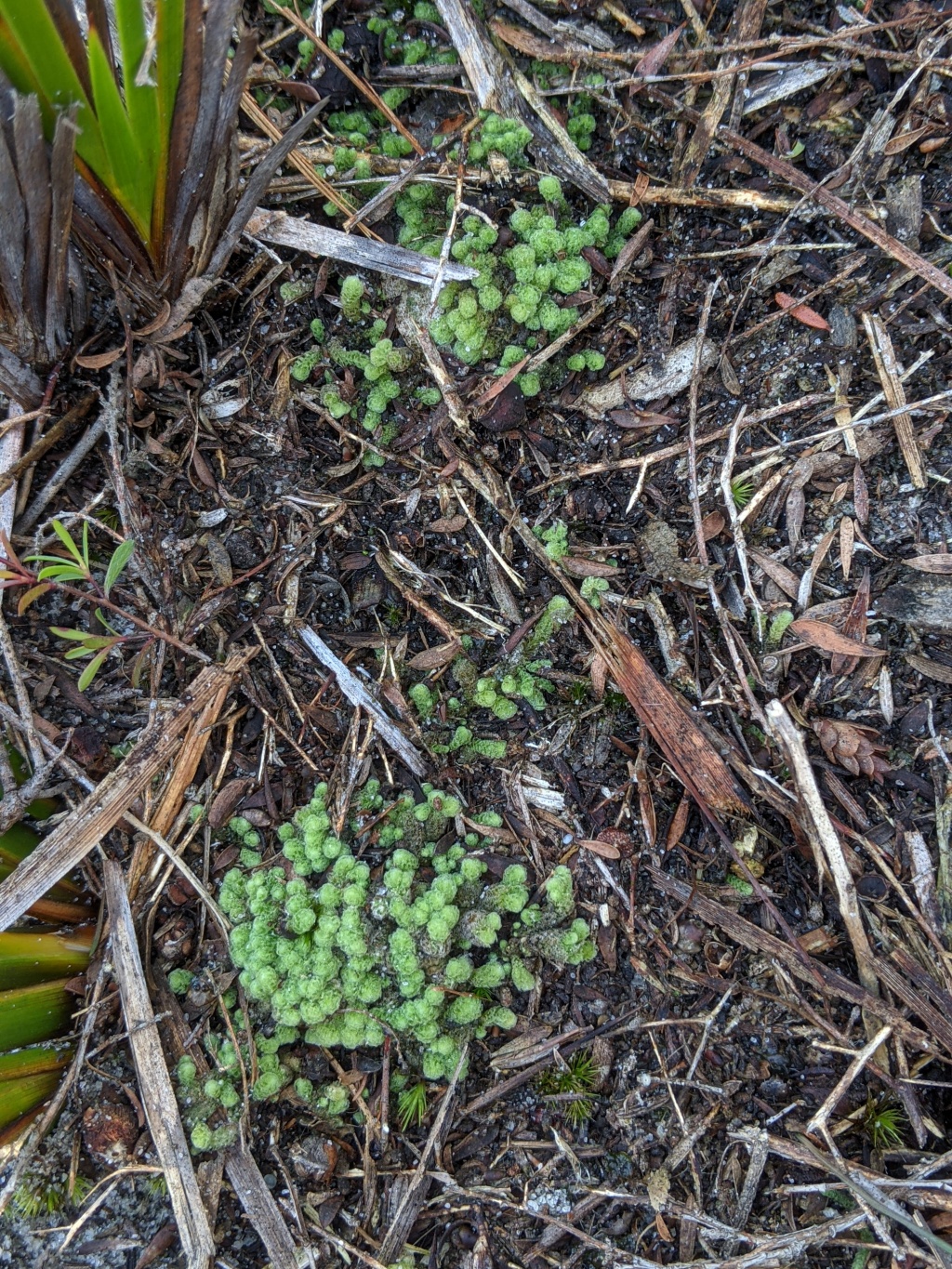
This is a highly distinctive liverwort easily distinguished both microscopically and in the field. In the field the shoots have a distinctive furry-like texture due to the leaves being densely imbricate, highly crispate and with cilia along the margins. The colour is also distinctive, often being a grey-green colour. The overall appearance is reminiscent of gummy worms. Microscopically, the 3–4 lobed crispate leaves with numerous unicellular cilia along the margins easily distinguishes this species from other Victorian liverworts. Goebelobryum unguiculatum can co-occur with C. whiteleggei and has cilia along its leaf margins and can look similar to less crispate plants of C. whiteleggei. However, in G. unguiculatum the cilia are multicellular and produce a marsupium.
Engel, J.J. & Glenny, D. (2008). A Flora of the Liverworts and Hornworts of New Zealand. Volume 1. Missouri Botanical Garden Press: St Louis.
 Spinning