
Jackiella curvata
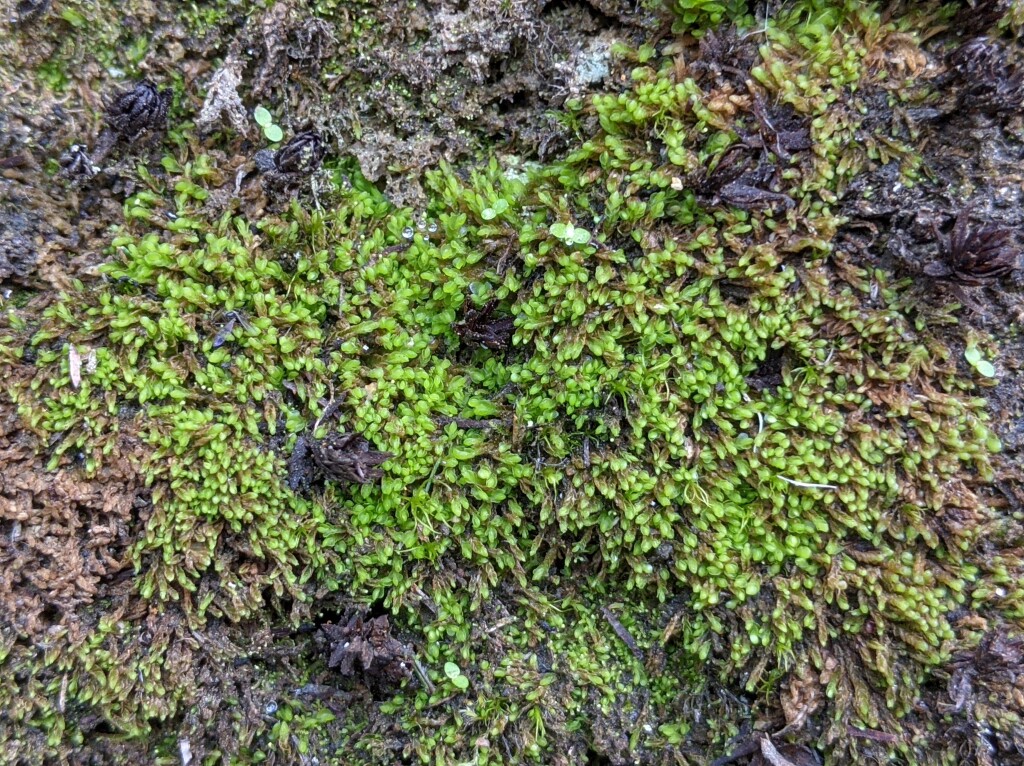
E.A.Hodgs. & AllisonTerrestrial, light green to brown. Asexual reproduction often by gemmae at attenuate shoot apices, ellipsoid, 2-celled. Stems prostrate, becoming erect. Lateral leaves semicircular to ovate, 275–800 μm long, 350–900 μm wide, insertion lines not extending to stem midline dorsally and leaving a leaf-free strip 1–2 cells wide, usually directed dorsally. Underleaves absent or vestigial, at its most developed narrow triangular or cilia-like, sometimes connate on one side to lateral leaf. Leaf cells hexagonal and ± isodiametric or elliptic, 20–58 μm long, 20–40 μm wide, thin-walled with large confluent trigones.
GGr, HSF, OtR, HFE, VAlp. On moist clay embankments of tracks that make openings in wet sclerophyll forest in the Otways, Eastern Highlands and East Gippsland. Also, New South Wales, Tasmania and New Zealand.
Despite having relatively simple morphology, this species is easily identified and is one of the more easily distinguished Victorian species with simple lateral leaves and no obvious underleaves. The large prominent trigones are very distinctive and when combined with the smooth cells and often semicircular leaves makes this species unmistakable.
 Spinning