
Syzygiella teres
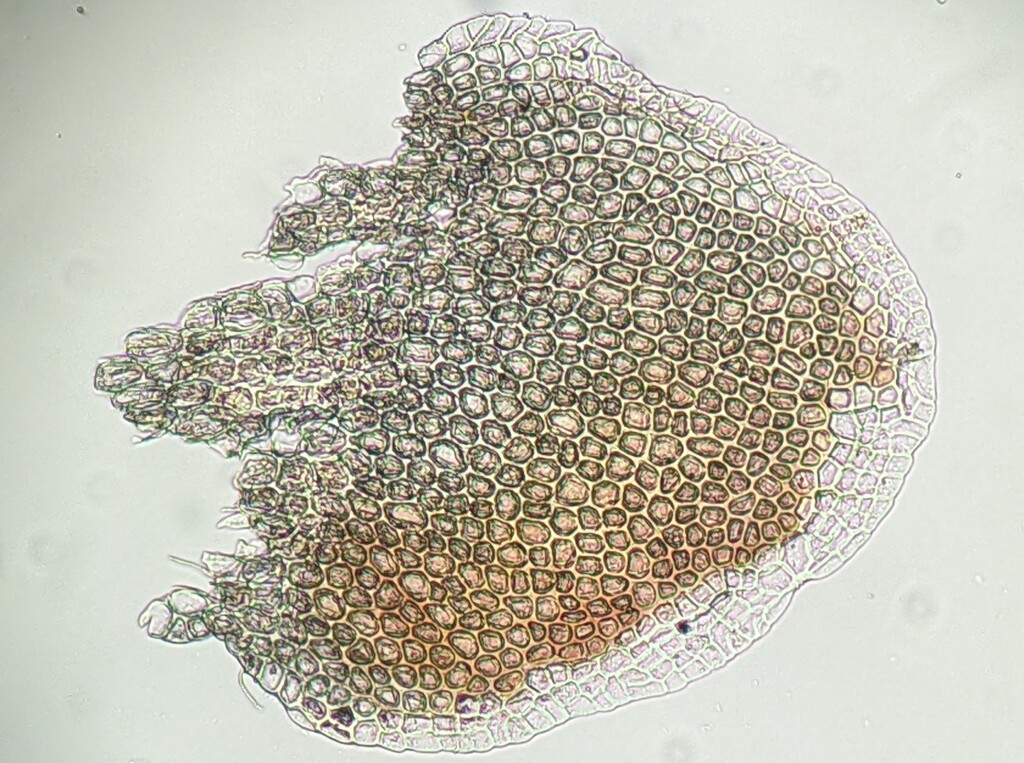
(Carrington & Pearson) VáňaDioecous. Shoots wiry, julaceous, prostrate, new growth light green but usually with age becoming dull to black-green, sometimes black or ferrugineous. Branches emerging from stems laterally and not associated with modified lateral leaves. Leaves orbicular-ovate, unlobed, 150–500 µm long, 125–525 µm wide, appressed to stem, concave, contiguous to imbricate, succubous, unistratose or occasionally bistratose near centre, crenulate to erose with age, sometimes margin incurved; lamina cells differentiated into photosynthetic cells and conspicuous marginal border of hyaline cells; photosynthetic cells mostly rounded quadrate to rounded rectangular, 15–26 µm long, 10–25 µm wide, mostly evenly thick-walled with small or indistinct trigones, coloured, but often becoming decolorate with age especially near marginal cells, smooth to minutely papillose, with 2–5 oil bodies; oil bodies globose to elliptic, finely papillose, pale smokey grey; marginal hyaline cells rectangular, polygonal or triangular, 15–23 µm long, 10–13 µm wide, thin-walled, without contents, minutely papillose, in up to 5 rows. Underleaves if present lanceolate, to 200 µm long and 60 µm wide, with hyaline and crenulate margin, fused for most of length to adjacent lateral leaf. Bracts in several imbricate series, the innermost longer than leaves, shallowly bilobed, and dentate to lobulate, with recurved margins, at least in sinuses. Bracteoles free from bracts, up to length of bract, unlobed or bilobed. Perianth ovoid, pluriplicate, lobulate and denticulate at mouth.
VAlp. Confirmed only from a single site in the alpine zone on Mount Buffalo, along a fast-flowing stream lined by boulders. Also, NSW, Tas, New Zealand, southern South America, Tristan da Cunha and Subantarctic Islands.
This species is often confused with the superficially similar Nothogymnomitrion erosum, which in Victoria is a much more common plant of alpine rock outcrops and rocky creeks. Both species have similar colouration, size, habitat and julaceous, worm-like shoots with appressed unlobed leaves with a hyaline margin. However, close inspection of leaves under the microscope will allow the two to be distinguished based on cells of the margin. In S. teres, the cells of the margin are thin-walled and not distinctly elongated relative to the photosynthetic cells. In contrast, N. erosum has distinctive thick-walled and elongated marginal cells that broaden at the ends like knobs, which project beyond the outline of the leaf. Often this margin of cells will erode, especially with age, giving the impression of absence of this elongated marginal cell row, however, inspection of several leaves will ensure that some intact margins will be seen. In the field, the two species are difficult to discern, but the shoots of N. erosum tend to be more erect and the plant forms a cushion, whereas in S. teres the shoots are more prostrate and the plant forms a mat that adheres close to the substrate.
Engel, J.J. & Glenny, D. (2008). A Flora of the Liverworts and Hornworts of New Zealand. Volume 1. Missouri Botanical Garden Press: St Louis.
 Spinning