
Andrewsianthus marionensis
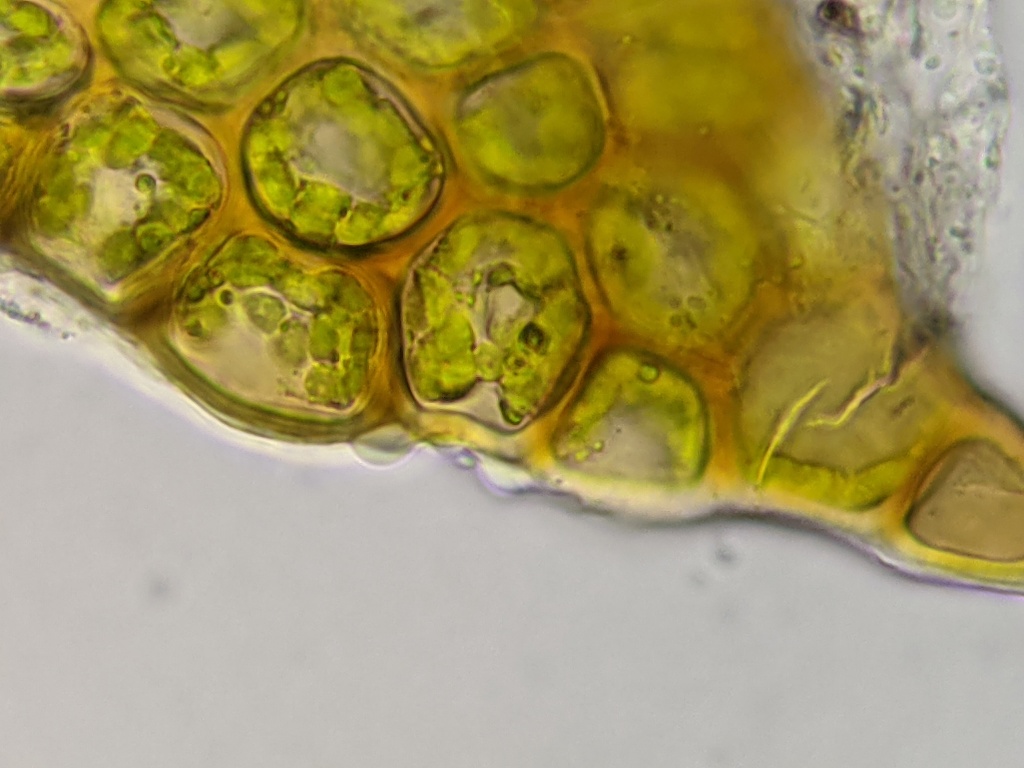
(S.W.Arnell) GrollePlants green to greenish brown or yellow brown, sometimes becoming flagelliform at shoot tips. Branches arising from axils of leaves, centred on centre base of leaf. Leaves oblong, oblate-orbicular or obtrapezoidal in outline, bilobed, 150–500 μm long, 160–375 μm wide, widely spreading to squarrose from erect and somewhat sheathing base, remote to contiguous, entire; lobes 1/5–½ length of leaf, sometimes with ventral lobe larger, acute or cuspidate, separated by V-shaped sinus. Underleaves vestigial, usually composed of two cells each with slime papillae. Laminal cells rounded-polygonal, 12–33 μm long, 7–20 μm wide, smallest at margin, clearly papillose, papillae usually hemispherical, becoming striate-papillose toward leaf base, with 2–5 oil bodies; oil bodies grey, spherical to ellipsoid, granular. Bracts in in 3 series, entire or dentate with one to several teeth, otherwise similar to vegetative leaves. Bracteoles present, 1/2–3/4 size of bract, free from bracts, with lobes unequal, entire or dentate with one to several teeth.
VAlp. Recorded only on a few occasions from rocky alpine areas throughout Victoria and likely largely overlooked, forming patches on soil accumulated in shaded rock surfaces and crevices or more cryptic and growing intermingled among much larger moss species. Also, Tasmania, New Zealand, Chile, Tristan da Cunha, Kerguelen Island and Marion Island.
The clear hemispherical papillae of the leaf cells allow this species to be distinguished from the other Victorian species A. perigonialis. However, in some plants this feature does not clearly develop, but will still produce some smaller papillae, that while harder to distinguish from A. perigonialis, still appears noticeably more papillose than the smooth or nearly smooth cell surface of A. perigonialis.
Engel, J.J. & Glenny, D. (2008). A Flora of the Liverworts and Hornworts of New Zealand. Volume 1. Missouri Botanical Garden Press: St Louis.
 Spinning