Grevillea celata
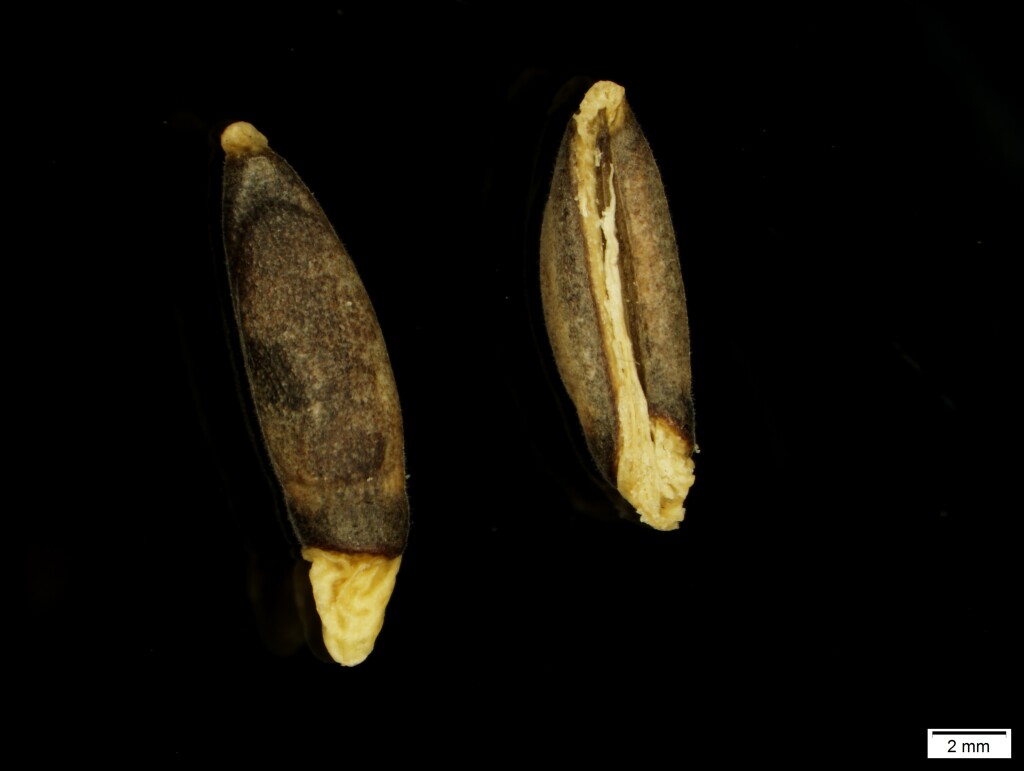
Molyneux Nowa Nowa GrevilleaErect and open, to low and dense, root-suckering shrub 0.4–1.8 m high. Leaves entire, oblong- to broadly elliptic, 20–44(–58) mm long, 4–18 mm wide; margins recurved to loosely revolute, seldom obscuring the tomentose lower surface. Conflorescences usually terminal on short lateral branchlets, occasionally axillary on older wood, usually simple, usually decurved, 2–8-flowered; rachis 1–5 mm long, pubescent; perianth typically red or pink in basal half shading to yellow or white above (rarely yellow throughout), basally dilated, outer surface irregularly pubescent, inner surface bearded; tepals (often only the dorsal pair) variably horned; pistil 18–25 mm long, ovary sessile, villous, style green at base shading to pink or red apically with a green style-end, dorsally villous in lower half, glabrescent above, pollen presenter lateral. Fruits tomentose, longitudinally ridged. Flowers Jul.–Feb.
GipP, EGL, EGU. Known only from the Colquhoun state Forest east of Bruthen where growing on red siliceous or pale granitic sands in dry sclerophyll forest.
Easily confused with Grevillea chrysophaea (which does not root-sucker and lacks red coloration on the perianth), and G. alpina (which does not root-sucker, has a more prominent tongue-like nectary, and usually a shorter pistil).
Makinson, R.O. (1996). Grevillea. In: Walsh, N.G.; Entwisle, T.J., Flora of Victoria Vol. 3, Dicotyledons Winteraceae to Myrtaceae, pp. 845–870. Inkata Press, Melbourne.
Spinning