
Schistochila pseudociliata
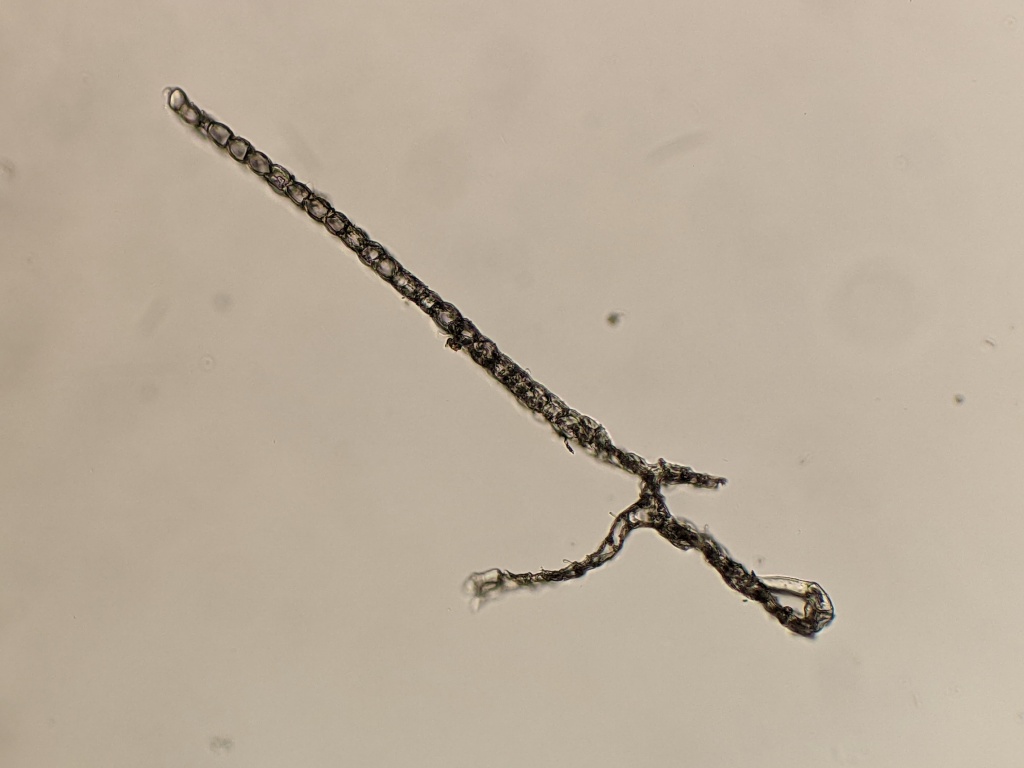
R.M.Schust.Prostrate, pale green to pale brown. Stems not decurved at apex; paraphyllia absent from vegetative stem. Lateral leaves incubously inserted, imbricate. Ventral lobe narrowly-ovate, 2250–3250 μm long, 675–1075 μm wide (not including cilia), without lamellae, unistratose, broadly rounded to obtuse at apex, with elongate cilia along margins, but becoming shorter near apex. Dorsal lobe 2050–2925 μm long, 750–1125 μm wide (not including cilia), free for 1/4–1/3 of its length, ovate, without lamellae, unistratose, obtuse to acute, ciliate along margins, remaining longer at apex than in ventral lobe, becoming laciniate near base. Keel between lobes unistratose, bearing two wings that continue along entire length of keel; wings unistratose, with ciliate margins, the ventral wing wider and decurrent along stem. Underleaves bilobed, subquadrate to subrectangular in outline, 750–1500 μm long, 525–1375 μm wide (not including cilia), contiguous to slightly imbricate, with ciliate to laciniate-lobulate margins, sometimes with a shelf-like protrusion in sinus facing substrate; lobes 0.4–0.5 of the underleaf length. Cilia usually on marginal projections 2 cells wide, rarely on projections 3 cells wide, composed of 3–6 cells in a single row. Leaf cells polygonal, 30–75 μm long, 25–43 μm wide, more elongate in cilia, where oblong to rounded-rectangular and 45–120 μm long, 20–43 μm wide, smooth, thin-walled with small trigones. Rhizoids magenta, in ill-defined fascicles at underleaf and lateral leaf bases near stem base. Reproductive material not seen.
Known from Victoria from one collection, with Warburton the only information provided. Also, Tasmania and New Zealand, however, the Victorian specimen may belong to a separate undescribed species (see notes below).
This collection here is tentatively assigned to S. pseudociliata. However, the specimen is aberrant for this species and its taxonomic status requires rediscovery and confirmation with more substantial material than what is currently provided in the existing collection. The above description is based solely on the Victorian specimen. Meagher (2010) identified this collection as Schistochila ciliata, based on the absence of unlobed underleaves (which are regularly present in typical S. pseudociliata), the presence of a double wing, (the dorsal wing is usually absent or present only in the apical half of the keel where it is rudimentary in typical S. pseudociliata), and cilia that arise from protruding bases more than two cells wide (cilia usually arise from bases two cells wide in typical S. pseudociliata). However, in the Victorian specimen cilia mostly arise from bases two cells wide, with bases wider than this rare, and the cilia are thin-walled, whereas in S. ciliata, the cilia bases are regularly more than two cells wide and the cells of the cilia are thick-walled (Renner et al. 2024). Additionally, the leaf cells in S. pseudociliata typically have large knot-like trigones (Engel & Glenny 2019), whereas in the Victorian collection the trigones are rather small.
Engel, J.J. & Glenny, D. (2019). A Flora of the Liverworts and Hornworts of New Zealand. Volume 3. Missouri Botanical Garden Press: St Louis.
Meagher, D. (2010). Schsitochila ciliata Steph. reinstated for Australia. Australasian Bryological Newsletter 58: 6.
Renner, M.A.M, Cargill, D.C., Meagher, D., Karunajeewa N., Franks, A. & Klazenga N. (2024). An updated checklist for the hornworts and liverworts of Australia. Telopea 28: 1–194.
 Spinning