
Riccardia crassa
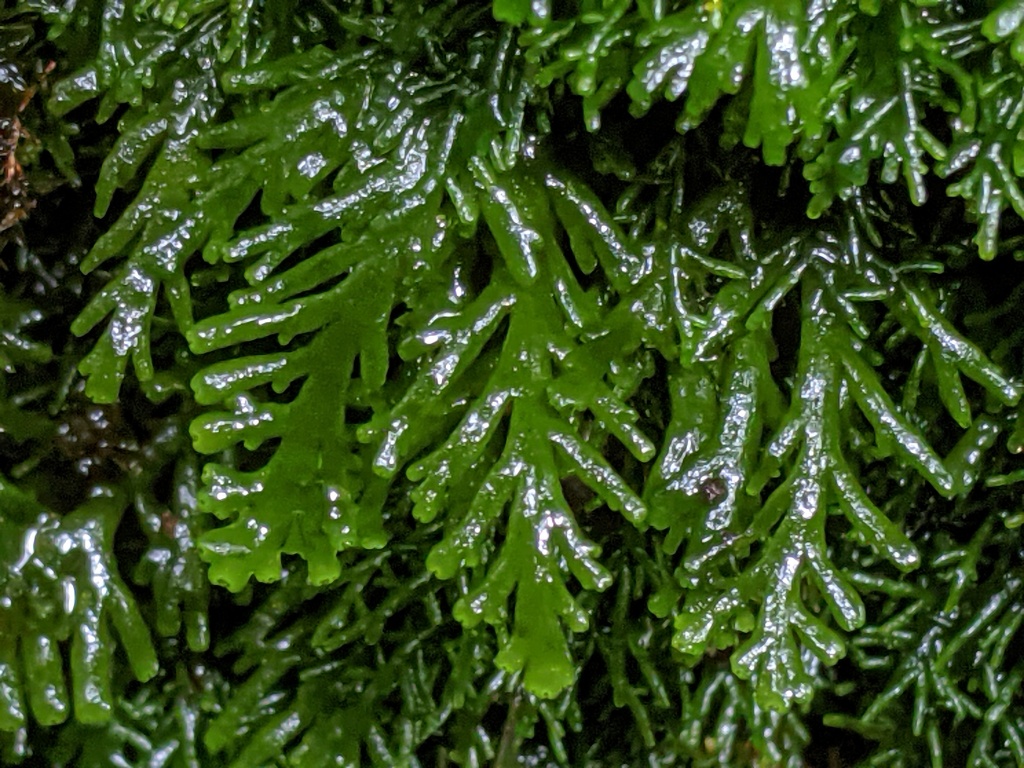
(Schwägr.) C.Massal.Dioicous. Gemmae produced occasionally near growing apex. Forming dense mats or cushions. Thallus 2–3 (–4)-pinnate, (5–) 10–30 (–40) mm long, (0.5–) 1–2 (–3) mm wide, plane adaxially and convex ventrally or biconvex in transverse section, with obtuse to acute margin, (5–) 6–10 (–12) cells thick, with a distinct notch at apex that gets overtopped by growth on both sides and protected by ventral non-persistent mucilage papillae, with an asperulate cuticle caused by striations. Oil bodies 1–3 (–4) per cell, some cells without oil bodies. Calyptra 3–5 mm long, with pachydermal cells scattered along calyptra and forming a rough cap of loosely aggregated cells near apex.
GleP, OtP, CVU, GGr, EGL, EGU, WPro, HSF, HNF, OtR, Strz, MonT, HFE, VAlp. Common in moist areas along and south of the Great Dividing Range on rock, soil or wood, often on wet embankments of tracks, and along creeks. Also, Western Australia, South Australia, New South Wales, Australian Capital Territory, Tasmania and New Zealand.
Hewson, H.J. (1970). The family Aneuraceae in Australia and New Guinea: II. The genus Riccardia. Proceedings of the Linnean Society of New South Wales 95: 60–121.
 Spinning