
Radula australiana
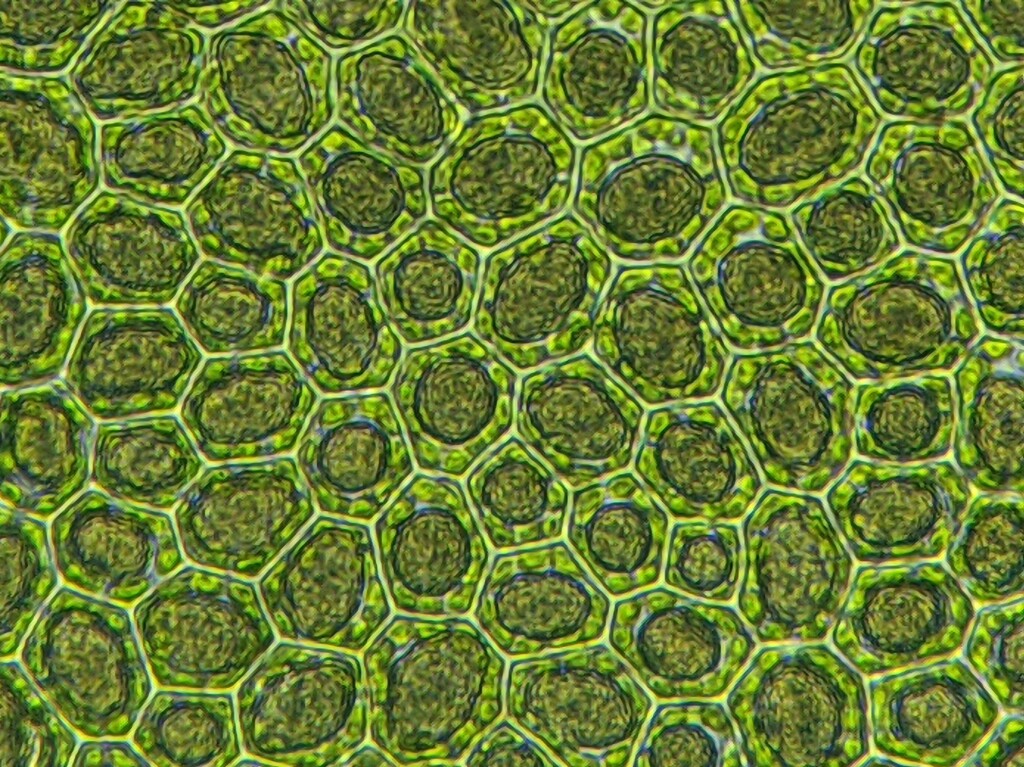
K.YamadaEmerald to dark green mats, dioicous. Specialised asexual propagules absent. Leaves rotund, oblong, or elliptic with a triangular base, not falcate, 425–1650 μm long, 275–1500 μm wide, rounded at apex, continuous to imbricate, inserted at dorsal mid-line leaving no continuous row of cells uninterrupted by leaf insertions, not inserted at ventral mid-stem and leaving 2 rows of cells uninterrupted by leaf insertions, extending over dorsal side of stem often reaching or sometimes exceeding the opposite side of stem, attached to lobule by a straight to slightly bulging keel; lobe margin entire or crenulate, not descending below the level of the keel and forming a distinct notch at intersection, but instead often seamlessly continuing the curve or line of the keel; lobule quadrate, 1/6–1/4 of lobe area on leading shoot, 175–725 μm long, 225–650 μm wide, with obtuse or apiculate apex, free and extending half way or more over the ventral stem before attachment; leaf lobe cells rounded-polygonal, not forming a vitta, 9–25 μm long, 6–23 μm wide, thin-walled, with small triangular trigones, smooth, with 2–3 oil bodies; oil bodies light brown, granular, homogenous. Perianth 1500–4700 μm long, 875–1250 μm wide.
EGU, HNF, HFE, VAlp. In crevices and in shelter of boulders among rock outcrops and near creeks in the alpine zone of the alps and among rock outcrops in montane forest at Mount Ellery and near Mount Baw Baw. Also, New South Wales, Australian Capital Territory, Tasmania and New Zealand.
 Spinning