
Diplophyllum obtusifolium subsp. domesticum
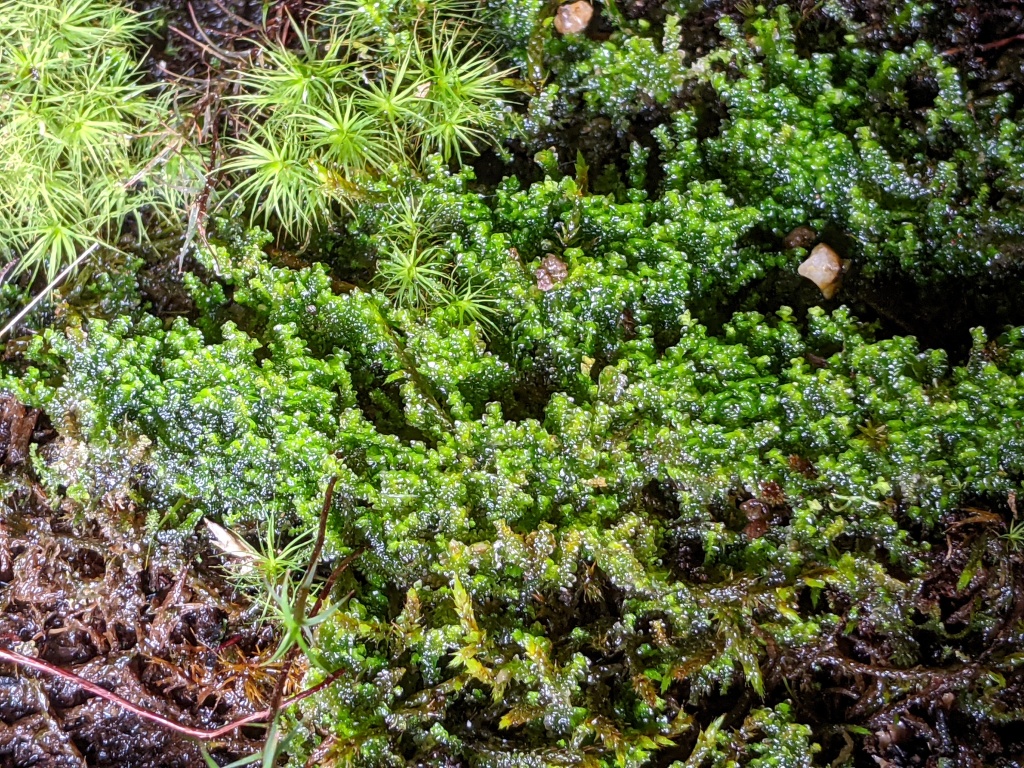
(Gottsche) VáňaTerrestrial or lithophytic, green or salmon-pink, paroicous. Asexual reproduction by 1-celled, polygonal gemmae formed in chains from margins of leaves near stem apex. Stems prostrate, with the tips ascending. Lateral leaves falcate, with a smaller dorsal lobe lying over the larger ventral lobe, horizontally spreading, contiguous to imbricate. Ventral lobes obovate-oblong to lingulate-falcate, 0.5–1.25 mm long, 0.225–0.55 mm wide, denticulate, becoming irregularly serrulate near base, with rounded, truncate, acute or apiculate apex, forming a keel with adaxial lobule for 0.25–0.3 of length. Dorsal lobe lingulate-falcate to ovate or obovate, 0.325–0.65 mm long, 0.175–0.425 mm wide, 0.5–0.7 of the abaxial lobe length, plane, denticulate, rounded, truncate, acute or apiculate at apex. Leaf cells near keel and midline of ventral lobe rectangular 19–68 µm long, 7–20 µm wide, elsewhere quadrate 7–20 µm long, 7–18 µm wide, evenly thick-walled without trigones, papillose, with 2–3 oil bodies in cells of apical half; oil bodies spherical to ellipsoid, finely papillose. Rhizoids dense along ventral stem, occasionally from near base of ventral lobe. Bracts similar to vegetative leaves except larger and with uniformly truncate to rounded lobe apices. Bracteoles absent. Perianth broadly ovoid to short ellipsoid, pluriplicate, white, lobulate and denticulate at mouth.
HNF, VAlp. Throughout the Victorian Alps in alpine and subalpine sites, usually in seepages and beside creeks and streams, deeply shaded by rocks and boulders. Also, New South Wales, Australian Capital Territory, Tasmania, New Zealand, southern South America and Subantarctic Islands.
 Spinning