
Gymnomitrion incompletum
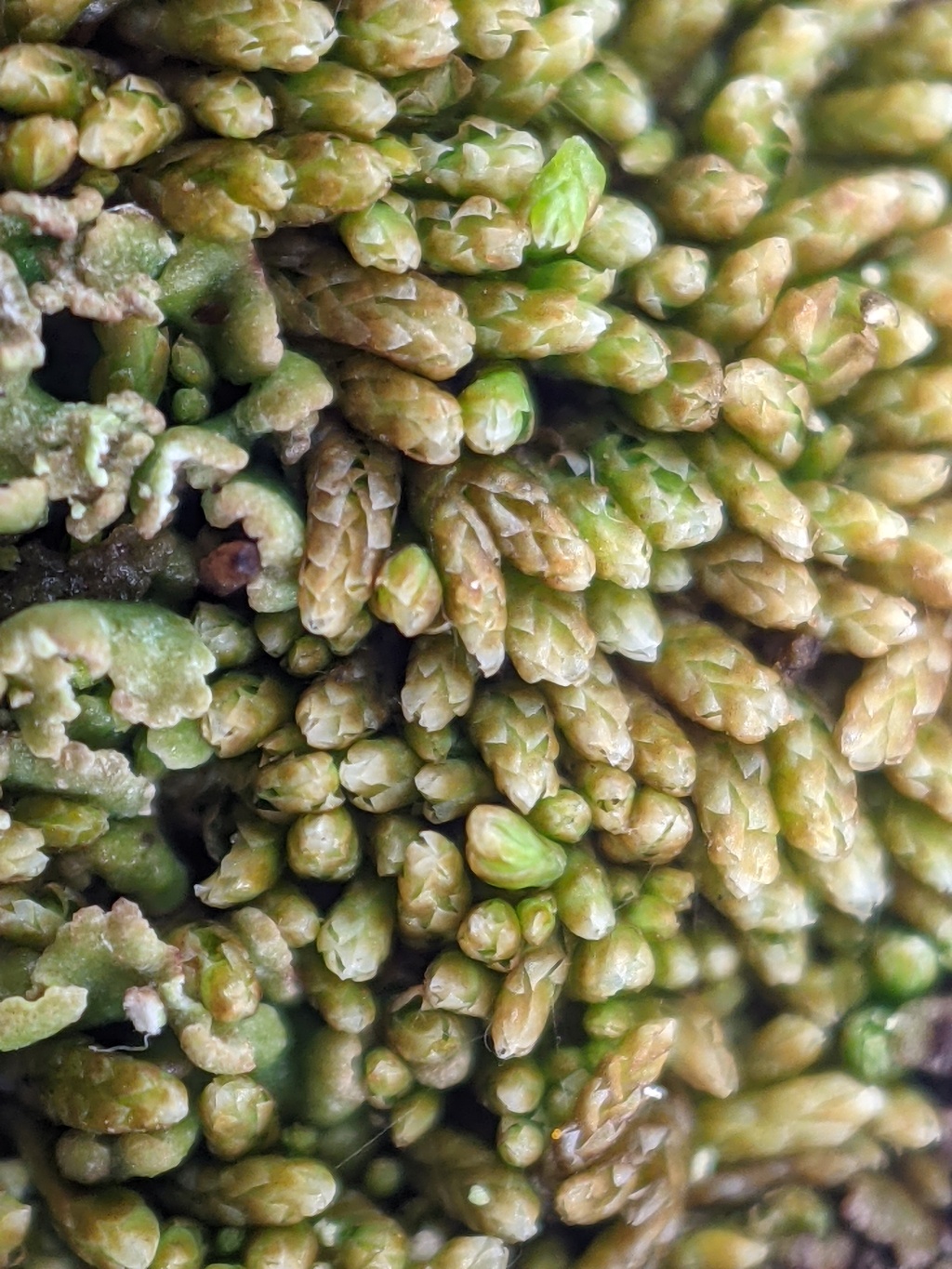
(Gottsche) R.M.Schust.Dioecious. Dense low cushions, yellowish-grey to brownish-green, comprising short erect stems. Branches emerging from stems laterally and usually in axil of unmodified leaf, rarely leaf next to branch unlobed. Leaves quadrate or oblong to broadly ovate in outline, bilobed, 350–800 μm long, 225–750 μm wide, incubous, imbricate, appressed to stem, irregularly crenulate, becoming decolorate along margins and often throughout entire lobes; lobes triangular, acute or apiculate, often flexed outwards, 1/5–1/2 length of entire leaf. Leaf cells quadrate to elliptic, longest toward basal centre, smallest at margin, 9–35 μm long, 7–22 μm wide, thick-walled, with large trigones, minutely asperulate. Androecia with bracts similar to vegetative leaves, but slightly larger and more ventricose, each with 1–2 (–3) antheridia. Gynoecia appearing clavate, with several series of leaf-like bracts becoming progressively larger to 1325 μm long and 900 μm wide, then with several 3-lobed bracts becoming smaller, connate and with increasingly more piliferous apices. Perianth absent. Elaters bispiral. Spores verruculose.
VAlp. Widespread throughout the Victorian Alps where a component of bryophyte communities among rocky cliff lines and outcrops in the alpine zone. Also, New South Wales and Tasmania.
Gymnomitrion incompletum is similar in overall appearance to Nothogymnomitrion erosum and Syzygiella teres, which are also alpine liverworts that grow with G. incompletum. All species have appressed leaves and decolorate margins. However, G. incompletum has more deeply divided leaves and the two lobes can be seen with careful inspection, especially in larger leaves, in the field. In contrast, S. teres has simple leaves and N. erosum is emarginate or so slightly bilobed that the lobes cannot be distinguished clearly in the field. When fertile the species are also easily distinguished. Gymnomitrion incompletum does not produce a perianth, whereas the others have distinct perianths.
 Spinning