
Plagiochila fuscella
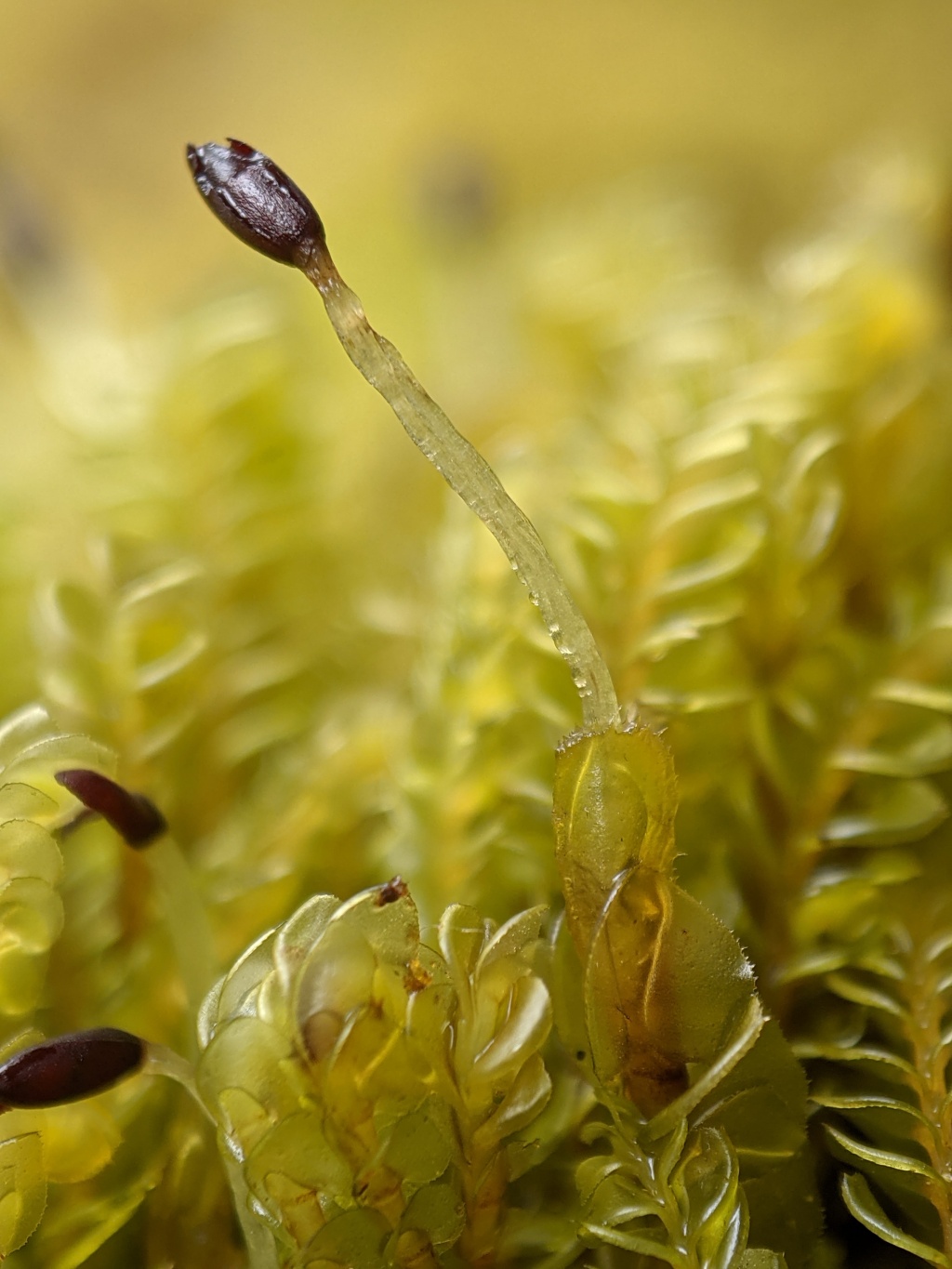
(Hook.f. & Taylor) Taylor & Hook.f. ex Gottsche, Lindenb. & NeesPlants forming yellow-green to bronze dense turfs. Specialised asexual propagules absent. Stems erect or arching away from substrate, circinate at apex; branches occasional and emerging from stem laterally and never next to a narrower leaf. Leaves asymmetrically broadly ovate, in mid-stem 1375–2750 μm long (from apex to closest attachment), 1450–3100 μm wide, rounded at apex, often undulate, remote to imbricate, spreading obliquely from stem with dorsal margin close to level with stem and oriented vertically or surface angled toward stem apex and together with opposing leaf row appearing V-shaped from below, dorsal margin revolute, slightly curved so that apex is clearly to the dorsal half of leaf, ventral margin plane, with 35–110 small teeth usually 1–2 cells long, sometimes to 3–4 celled on ventral margin, without a more prominent tooth at apex. Underleaves absent. Leaf cells polygonal to quadrate, (12–) 16–35 μm long, (9–) 15–23 μm wide, more elongate at basal center and to 100 μm long and 25 μm wide, thin-walled with small trigones, evenly thick-walled at margin, with 1–4 oil bodies; oil bodies ellipsoid, hyaline, granular. Androecia on leading stems and branches, with 3–9 pairs of bracts, each with a single antheridium and denticulate like vegetative leaves. Gynoecia at apex of leading stem and branches; bracts similar to normal leaves but more densely, prominently and irregularly toothed. Perianth compressed obovoid, to 5500 μm long and 2500 μm wide; mouth truncate, spinose-dentate. Capsule ellipsoid, 7–8-stratose. Elaters bispiral.
OtP, HNF, OtR, HFE. Recorded from rocks in and beside fast-flowing streams, mostly to the south of the Great Dividing Range. Also, New South Wales, Tasmania and New Zealand.
This species has been included in Plagiochila retrospectans, and while closely related, forms an exclusive group in DNA phylogenies distinguished from P. retrospectans by lacking a single more prominent tooth at the apex and by a less curved dorsal margin that results in the apex being more clearly positioned to the dorsal half of the leaf (Renner et al. 2017; Renner 2018).
Renner, M.A.M., Patzak, S.D.F., Heslewood, M.M., Schäfer-Verwimp, A. & Heinrichs, J. (2017). Third time lucky? Another substantially revised sectional classification for Australasian Plagiochila (Plagiochilaceae: Jungermanniopsida). Australian Systematic Botany 30: 70–104.
Renner M.A.M. (2018). A revision of Australian Plagiochila (Lophocoleinae: Jungermanniopsida). Telopea 21: 187–380.
 Spinning