
Chiastocaulon biserialis
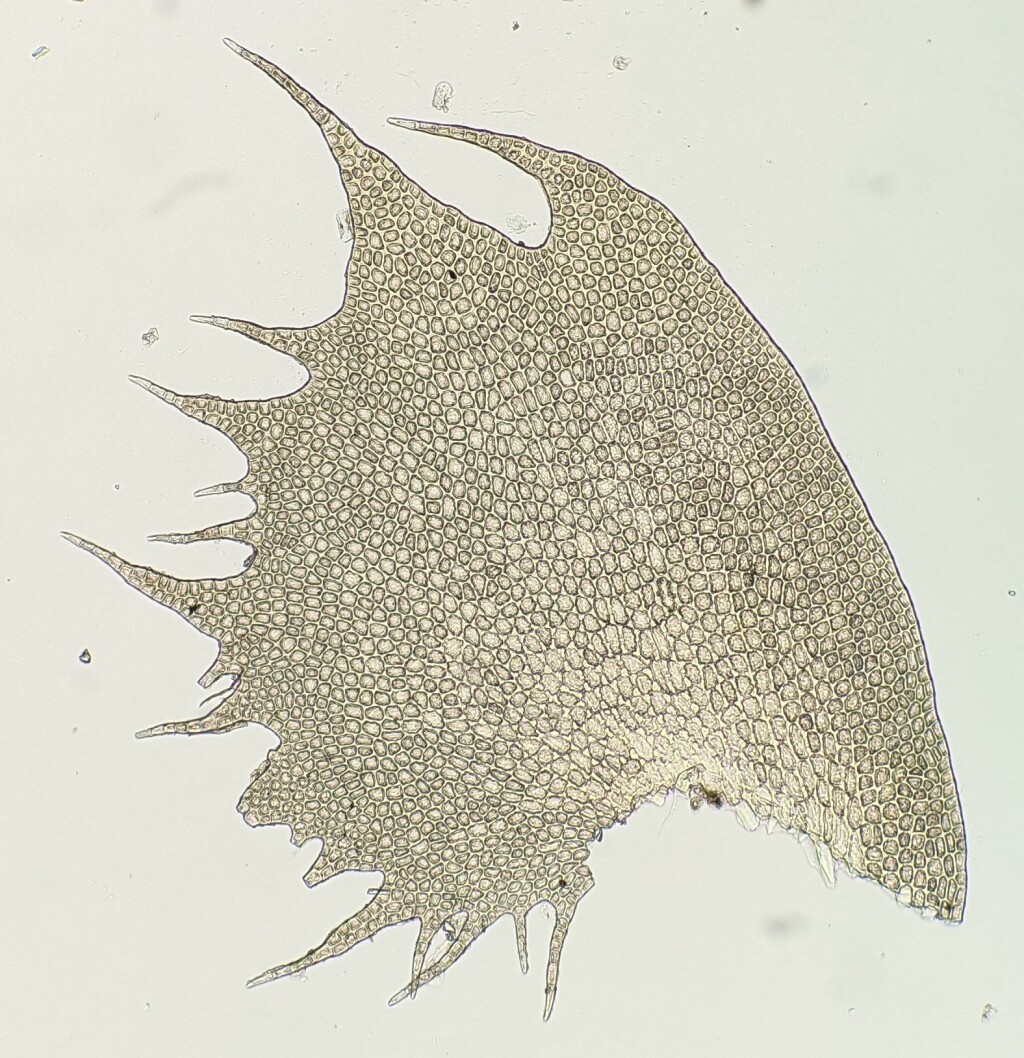
(Lehm. & Lindenb.) S.D.F.Patzak, M.A.M.Renner, Schäf.-Verw. & HeinrichsPlants olive-green. Stems erect, circinate; branches sparse, emerging from stem ventrally. Leaves asymmetrically rotund in outline with long-extended dorsal margin forming a decurrency, with multiple lobes grading to teeth ventrally, 600–1375 μm long, 675–1275 μm wide (not including lobes or teeth), densely imbricate, oriented vertically and ventrally secund, apex flaring outwards from stem when moist, entire up to first dorsal lobe, margins plane; lobes arching toward ventral side, consisting of a triangular base terminated by a single row of up to 7 cells, largest to ¼ of leaf length. Underleaves absent. Leaf cells quadrate to elliptic 12–35 μm long, 8–25 μm wide, becoming rectangular in central basal field where 30–65 μm long, 18–28 μm wide, thin-walled with large and often confluent trigones and intermediate thickenings in basal field, becoming thick-walled toward margin, smooth, with 4–6 oil bodies; oil bodies spherical to ellipsoid, greyish, papillose. Androecium of 5–13 pairs of bracts, each with a single antheridium. Perianth obovoid, laterally compressed, 2.2–2.6 mm long, with a truncate and dentate mouth. Capsules 4–5-stratose. Spores granulate.
HSF, VAlp. Known in Victoria only as an epiphyte in montane Nothofagus cunninghamii rainforest south of Powelltown and on Mount Donna Buang. Also, Tasmania and New Zealand.
 Spinning