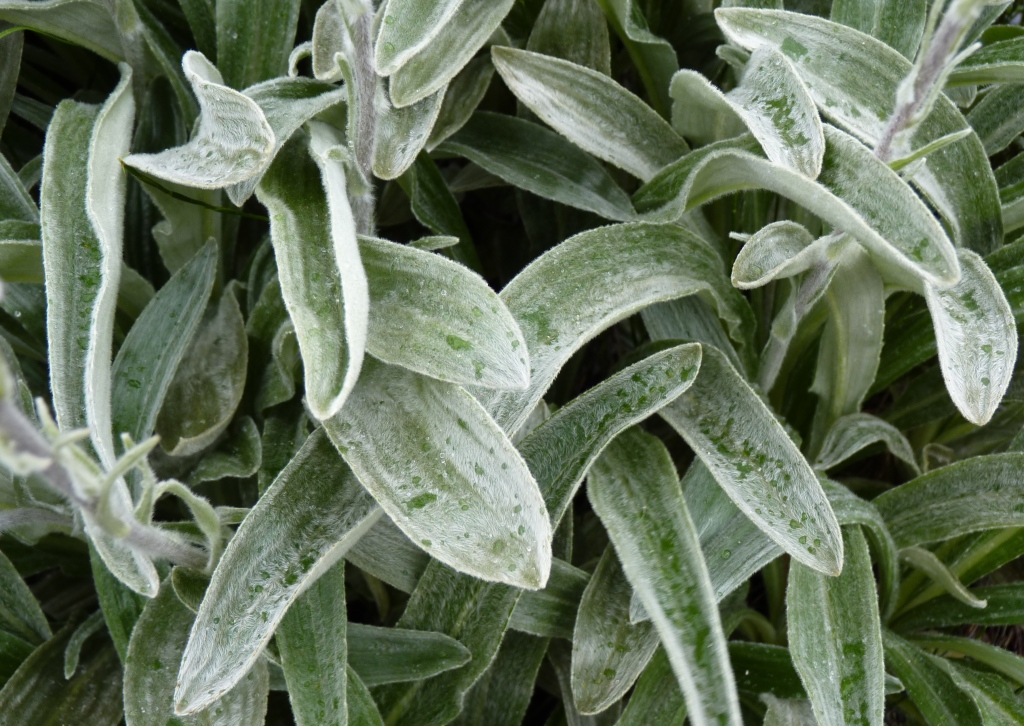
Celmisia sericophylla
J.H.Willis Silky Snow-daisyRootstock woody, branched; fibrous leaf remnants persistent. Leaves oblanceolate to narrowly oblanceolate or elliptic, c. 5–25 cm long, 1–3.5 cm wide, both surfaces velvety, with antrorse flattened lustrous hairs, denser and silvery beneath, margins flat, leaves renewed annually. Scape (6–)10–45 cm high, greenish-white, silky- or woolly-tomentose; capitulum c. 4–6 cm diam; intermediate involucral bracts narrowly triangular-subulate, 10–15 mm long, 1.3–1.9 mm wide, densely tomentose with silvery hairs, tip flushed red or purple, margins densely fimbriate; ligules 14–18 mm long, white. Cypselas c. (3–)4–6 mm long, densely sericeous; pappus c. 5–6 mm long. Flowers Dec.–Feb.
HNF, VAlp. Endemic in Victoria. Restricted to the Bogong High Plains, especially between Mt Bogong and Mt Cope, with a small outlying occurrence between Mts Loch and Hotham. Typically forming extensive carpets along rocky stream banks, or tufted among boulders and on rocks overhanging water, occasionally in Sphagnum bogs and wet areas below snow patches.
This species is distinct from all other mainland Australian species in that the leaves rot away under winter snow-cover and are replaced annually. The hairs of the upper surface of the leaf do not form the flat silvery pellicle characteristic of most other species in the genus.
Gray, M.; Given, D. (1999). Celmisia. In: Walsh, N.G.; Entwisle, T.J., Flora of Victoria Vol. 4, Cornaceae to Asteraceae, pp. 912–916. Inkata Press, Melbourne.
Spinning