
Poa fordeana
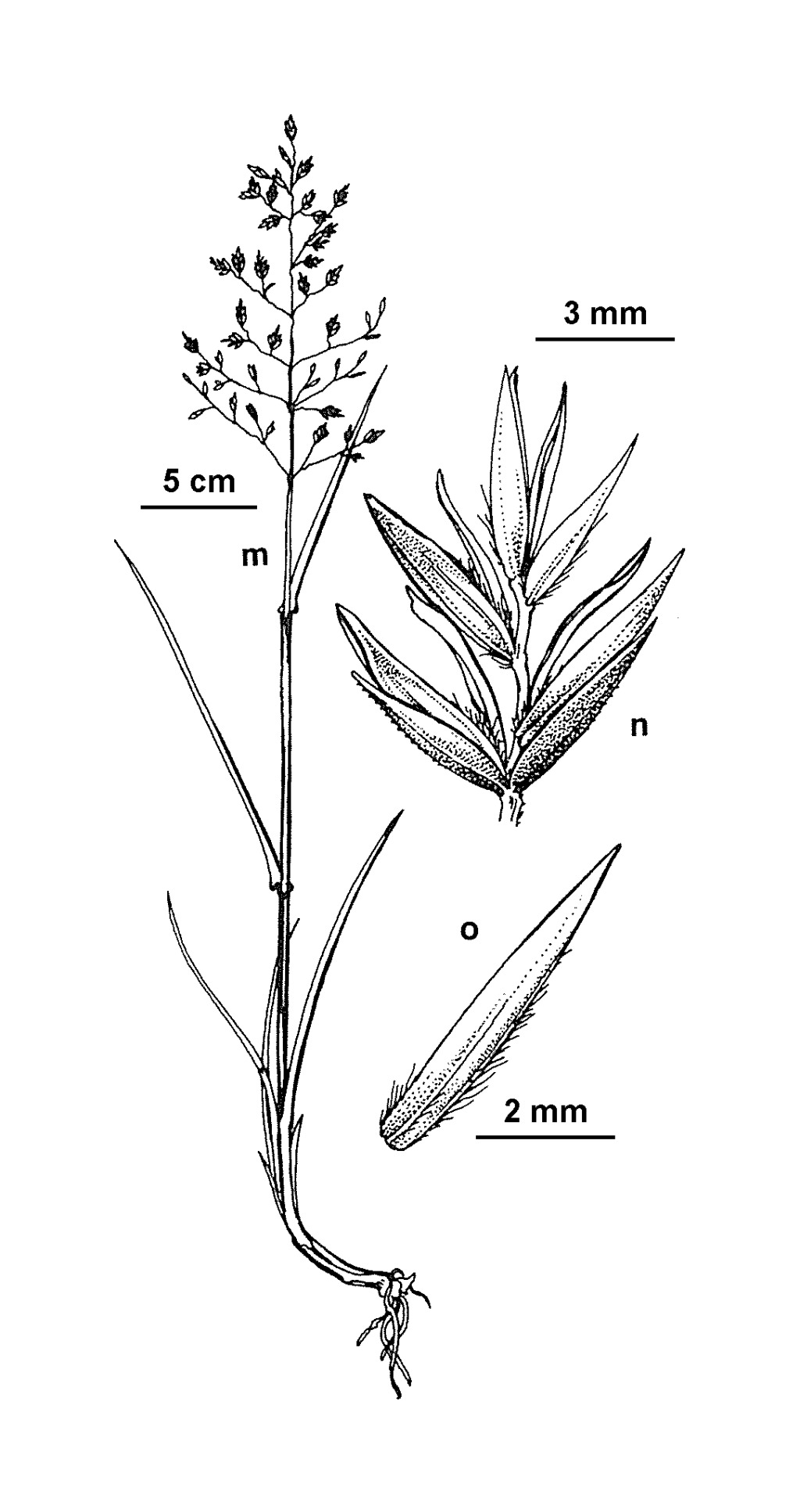
F.Muell Forde PoaRhizomatous perennial, producing slender, sometimes aggregated tussocks, culms ascending to erect, strongly compressed in the upper part, to 1 m high. Leaves glabrous; sheath tubular in lower part, brown, papery and often puckered near base; blade flat, rather thin, to 30 cm long and 4 mm wide, usually somewhat scabrous, evenly tapered to a narrowly acute apex; ligule thinly membranous, obtuse, 1–5 mm long. Inflorescence a narrow, oblong panicle, the branches tardily diverging, mostly to c. 20 cm long and 8 cm wide. Spikelets mostly 5–8-flowered, 5–11 mm long; glumes subequal, 3(–5)-nerved, 2–4 mm long, smooth along keel; lemma 5-nerved, 2.5–5 mm long, hairy on the back in the lower half, with longer, denser hairs on the keel and margins, occasionally the internerves glabrous; web not or weakly developed. Flowers Sep.–Dec.
LoM, MuM, Wim, VRiv, MSB, RobP, MuF, GipP, Gold, NIS. Also SA, Qld, NSW. Occasional on heavier soils prone to inundation in the north-west of the State, mostly along the lower Murray floodplain, extending as far east as the Yarrawonga area and south to near Horsham.
Walsh, N.G. (1994). Poaceae. In: Walsh, N.G.; Entwisle, T.J., Flora of Victoria Vol. 2, Ferns and Allied Plants, Conifers and Monocotyledons, pp. 356–627. Inkata Press, Melbourne.
 Spinning