
Plagiochila circinalis
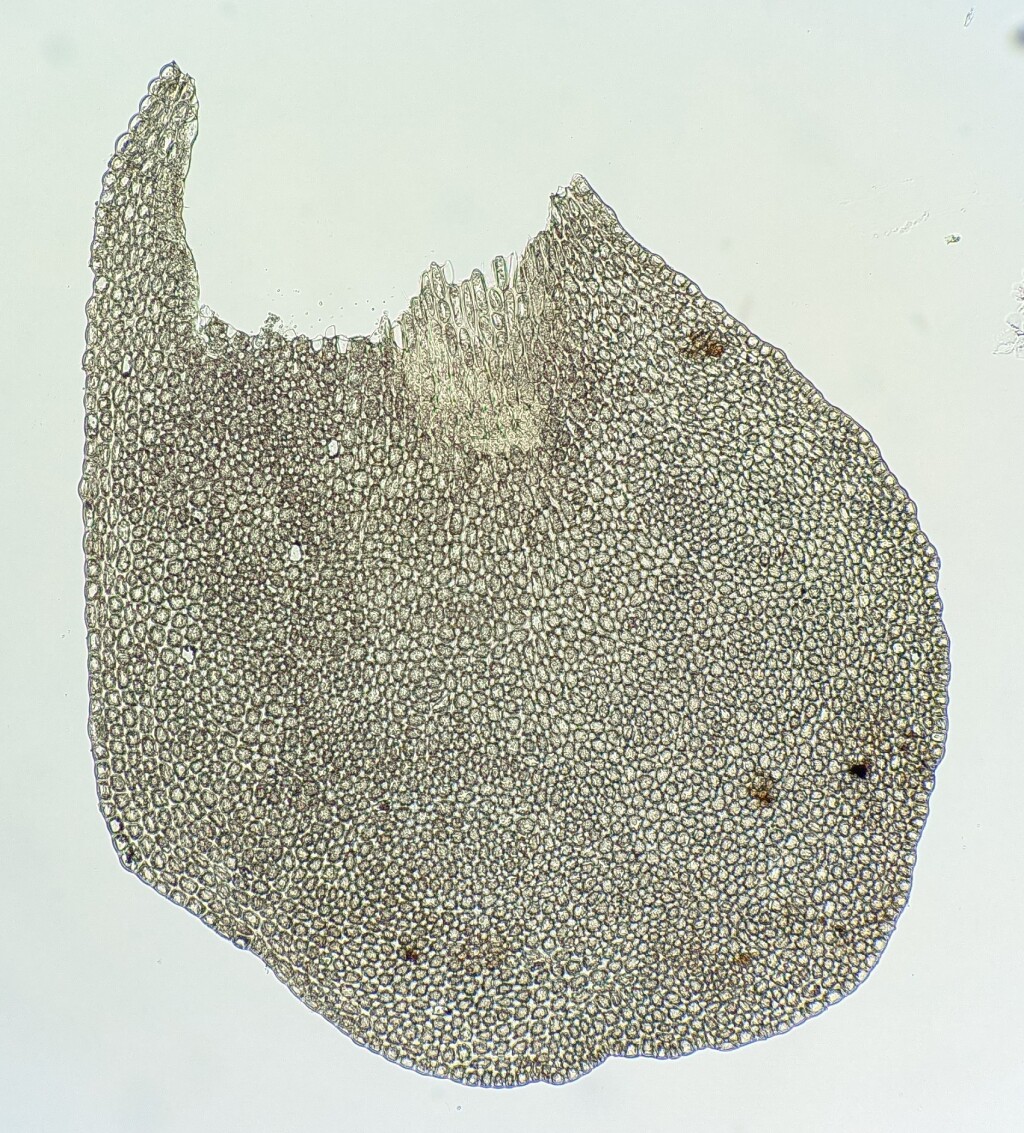
(Lehm. & Lindenb.) Lehm. & Lindenb.Plants pale green to bronze or brownish. Specialised asexual propagules absent. Stems arching away from tree and often curved downward near apex; branches sparse, emerging from leafy stems laterally and not associated with a narrowed leaf. Leaves asymmetrically broadly ovate or orbicular, becoming larger toward stem apex, in apical half of stem 950–2100 μm long (not including dorsal decurrency), 800–2325 μm wide, truncate to broadly rounded at apex, imbricate, ventrally secund, dorsal margin strongly revolute, ventral margin undulate, entire to crenulate. Underleaves absent or rarely vestigial and 2–3 celled. Leaf cells polygonal, 17–33 μm long, 15–28 μm wide, becoming more elongated to 50 μm long at basal centre, thin-walled with large confluent trigones, usually with 3–5 oil bodies in medial cells; oil bodies ellipsoid, coarsely botryoidal, smoky grey or hyaline. Androecia on short branches, ventrally secund, single or more commonly in groups of 3–5 clustered at shoot apex, with 5–9 pairs of bracts, each entire and with 1–2 antheridia. Gynoecia at apex of leading shoot; bracts obovate, often more toothed than normal leaves, innermost series appressed to perianth. Perianth oblong, 4–5 mm long, 2.3–3.1 mm wide, inflated in basal half, strongly compressed near mouth; mouth truncate or weakly rounded, entire to denticulate. Capsule ellipsoid, (6–) 7–8 (–9)-stratose. Elaters bispiral.
HSF, OtR, HFE, VAlp. Rarely recorded in Victoria from trees and boulders in tree fern gullies, rainforest and montane forest east from the Otways. Also, Tasmania and New Zealand.
 Spinning