
Dinckleria pleurata
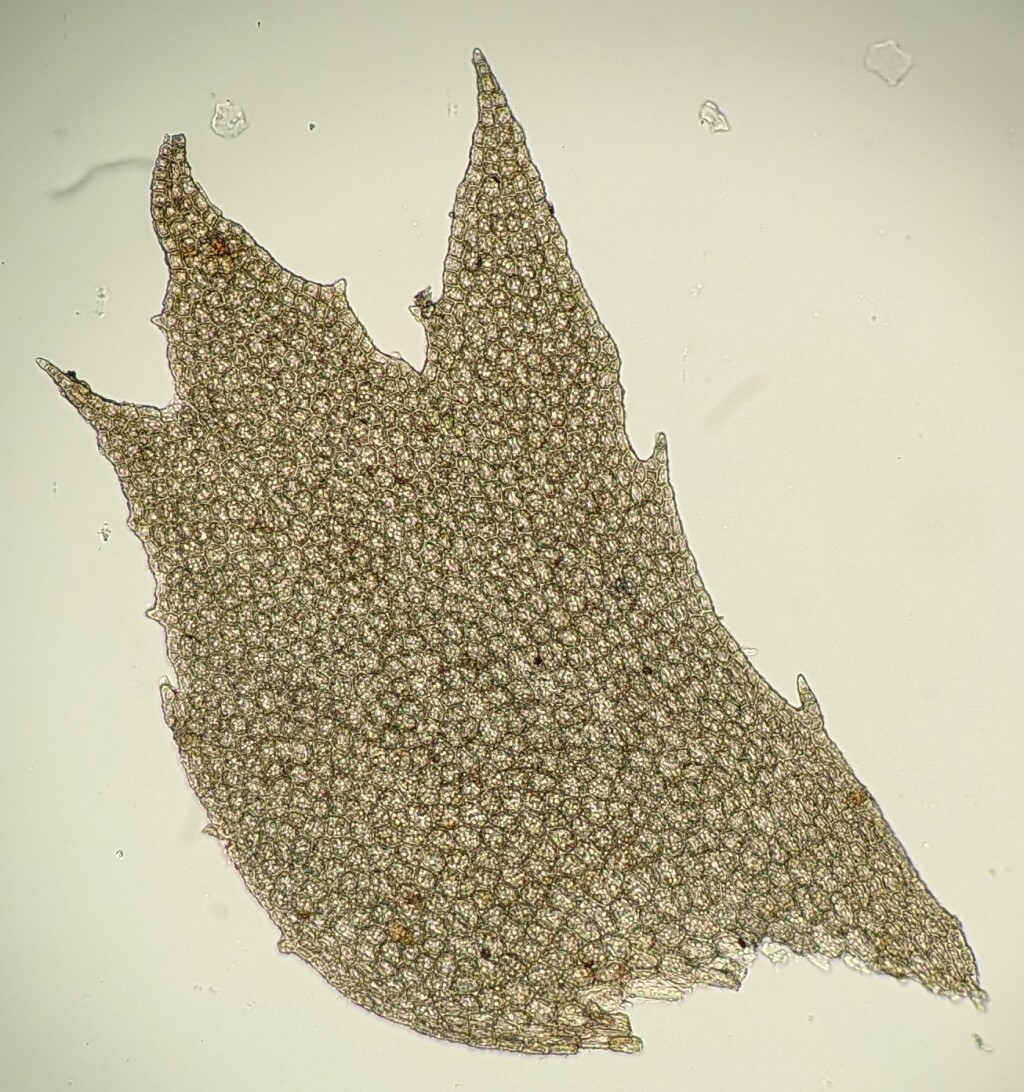
(Hook.f. & Taylor) Trevis.Stems erect, papillose; leafy branches emerging from leafy stems laterally and not associated with a narrowed leaf. Leaves asymmetrically ovate to oblong in outline, bi- or trilobed or lobes reduced to teeth, those of stem away from base 650–1350 μm long, 450–700 μm wide, obliquely spreading, insertion line extending to stem midline dorsally, remote to imbricate, margins revolute in basal half, entire or dentate; lobes unequal, central or ventral lobe, when bilobed, largest, largest to 1/3 of leaf length, acute to short-acuminate, dentate or entire; leaf cells oblong to polygonal, 15–50 μm long, 14–30 μm wide, marginal row smaller, 12–30 μm long, 5–20 μm wide, thin-walled, thicker-walled along margin, with small trigones, pluripapillose, with 2–6 oil bodies; oil bodies ovoid to ellipsoid, brown, granular. Underleaves absent or vestigial. Androecia with 2–6 pairs of bracts, each with a single antheridium. Perianth stipitate, narrow-ellipsoid, 1.6–2.2 mm long, laterally compressed with 1–3 plicae on each face, twisted and ciliate-dentate at mouth.
VAlp. Recorded once in Victoria from cool-temperate rainforest on the western slopes of the Baw Baw Plateau. Also, Queensland, New South Wales, Tasmania and New Zealand.
 Spinning