
Plagiochila strombifolia
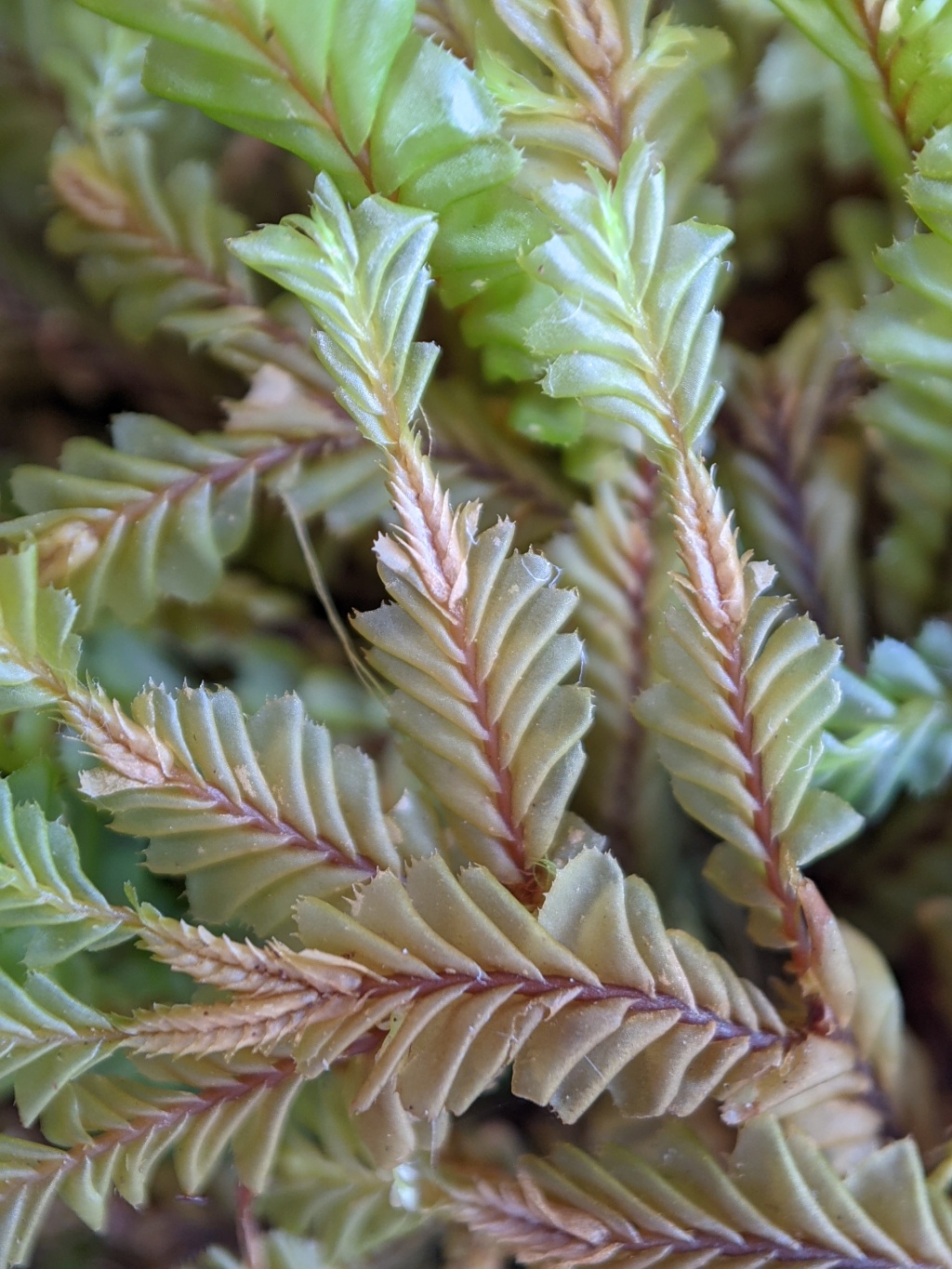
TaylorPlants dark green to olive-green and pale green at stem apices. Specialised asexual propagules absent. Stems arching away from substrate; branches infrequent and emerging from stem laterally and in when vegetative never next to a narrower leaf. Leaves asymmetrically ovate, away from base 1900–3375 μm long (not including dorsal decurrency), 1250–3100 μm wide (not including spinose teeth), longer than wide, rounded at apex, imbricate, spreading obliquely from stem with dorsal margin close to level with stem and gradually curving ventrally away from stem level toward ventral margin and sometimes ventral margin pointing downwards, dorsal margin recurved, ventral margin plane, with 8–29 teeth, terminating in a single row of (2–) 3–7 (–12) cells. Underleaves absent. Leaf cells circular, quadrate or oblong, 20–43 μm long, 18–25 μm wide, enlarged at basal center and to 58 μm long and 35 μm wide, thin-walled, with distinct trigones, thick-walled at margin, with 4–6 oil bodies in medial cells; oil bodies ellipsoid, smoky, homogenous. Androecia mostly in groups of 3–5 clustered at shoot apex, with 5–9 pairs of bracts, each with 1–2 antheridia and mostly entire, some sometimes with 1–2 small spinose teeth. Gynoecia at apex of leading shoot; bracts oblong-ovate to broadly ovate. Perianth urceolate, 3500–4100 μm long, 2100–3300 μm wide, inflated at base, laterally compressed toward mouth; mouth truncate, spinose-dentate. Capsule ellipsoid, (6–) 7–8-stratose. Elaters unispiral.
OtP, GGr, EGL, EGU, HSF, HNF, OtR, Strz, MonT, HFE, VAlp. One of the most abundant liverwort species on rocks and trees in rainforest, montane forest and gullies in wet forest, and also in protected rocky gorges and in well protected microclimates among rock outcrops east from the Grampians and along and south of the Great Dividing Range. Also, New South Wales, Tasmania and New Zealand.
 Spinning