Christella dentata
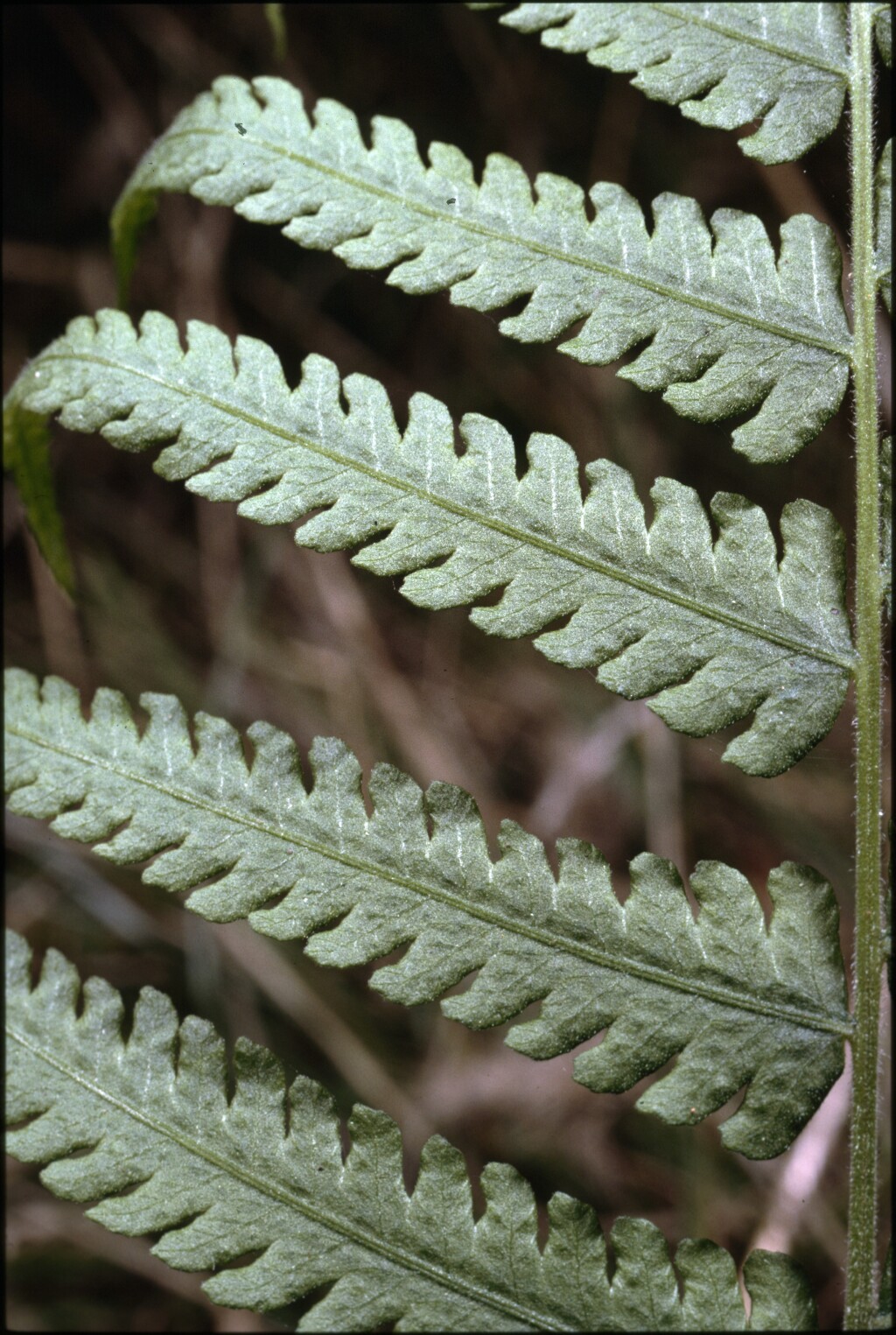
(Forssk.) Brownsey & Jermy BinungRhizome short and erect or very shortly creeping, sparsely covered in narrow brown scales. Fronds tufted, erect, 60–100 cm tall; stipe variable in length, almost succulent, densely hairy (giving young stipes a whitish bloom), flattened above, shallowly grooved, dark and scaly towards base. Lamina oblong-lanceolate, almost 2-pinnate, dark green to yellow-green, herbaceous, densely coated with short, pointed, multicellular hairs; rachis and pinna mid-rib deeply grooved (grooves not connecting), with numerous long, sometimes curved hairs. Pinnae narrow, tapering from base to acuminate apex; lobes short, oblong and slightly falcate, margins entire; lower pinnae well separated and progressively decreasing in length to become less than half as long as middle pinnae, basal lobes unequal; veins free except for lowest veins in adjacent lobes which join to form single excurrent vein. Sori copious, round; indusium kidney-shaped, covered with fine, pointed hairs; spores black.
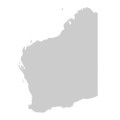
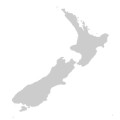
GipP, WaP, EGU. All mainland States. Sri Lanka, Malaysia, Taiwan. In Victoria, naturally occurring populations are apparently confined to a very few sites near Buchan, where growing on moist, shaded, limestone-derived soils. A collection of C. dentata (1883) from Curdies River near Port Campbell is correctly determined, however, it is uncertain whether the locality information is correct. Curdies River is also a known site for the superficially similar Pneumatopteris pennigera. Christella dentata is a common glasshouse weed and is occasionally found in disturbed suburban sites (e.g. Mt Martha).
Entwisle, T.J. (1994). Ferns and allied plants (Psilophyta, Lycopodiophyta, Polypodiophyta). In: Walsh, N.G.; Entwisle, T.J., Flora of Victoria Vol. 2, Ferns and Allied Plants, Conifers and Monocotyledons, pp. 13–111. Inkata Press, Melbourne.
 Spinning