Mesembryanthemum cordifolium
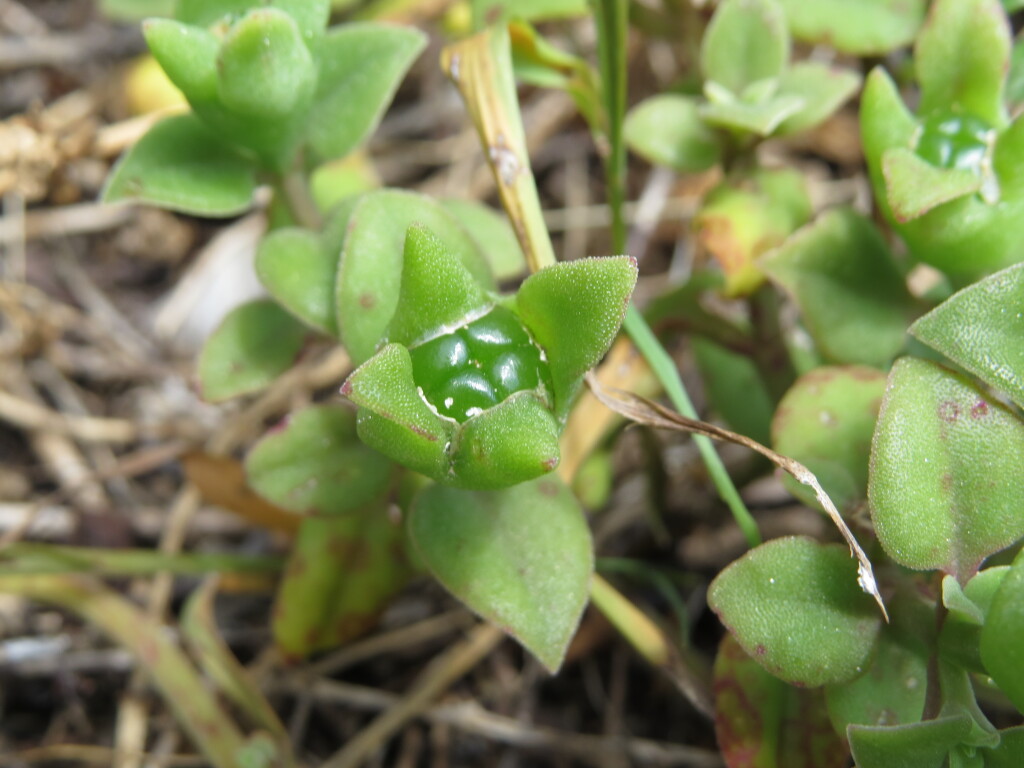
L.f. Heart-leaf Ice-plantSucculent perennial herb with scrambling or prostrate stems to 1.2 m long, minutely papillose, somewhat brittle. Branches angular (4-angled). Leaf lamina (10–)15–26(–35) mm long, 10–20(–25) mm wide, mostly cordate or broad ovate with somewhat truncate or obtuse base, some younger leaves can be ovate in plants with otherwise mostly cordate adult leaves, margin entire, apex acute (to obtuse), lamina mid green, often glossy, minutely papillate; petiole to 5–12 mm long. Pedicels 5–10 mm long, elongating in fruit; larger sepals ovate at anthesis, 9–11 mm long, 5–6 mm wide; smaller sepals linear or narrowly triangular, to 5–7 mm long, 3 mm wide; sepals enlarging in fruit. Flowers (8–)12–15 mm across. Staminodes deep pink or magenta. Stamens with filaments white, anthers pale yellow. Stigmas 1.5–1.7 mm long. Capsule shorter than calyx, obconic, 9–12 mm long, 4–9 mm wide, glossy green, later dry and brown. Seeds many, very hard, ± circular, with a flattened dorsal ridge, prominently tuberculate, 1–1.5 mm diam., brown. Flowers sporadically throughout the year, with a peak in mid to late summer and into autumn.
MuM, VVP, VRiv, GipP, OtP, Gold, CVU, EGL, HSF. MuM, VVP, VRiv, GipP, OtP, CVU, EGL, HSF. Also SA, NSW, Tas. Occurs in coastal sites (Melbourne area, Lakes Entrance, Marlo) and drier areas inland where saline or rocky (e.g. far northwest, Craigieburn, Keilor, Heyfield).
The widely cultivated Mesembryanthemum × vascosilvae (Gideon F.Sm., E.Laguna, Verloove & P.P.Ferrer) L.Sáez & Aymerich ‘Red Apple’ which is an artificial hybrid of garden origin obtained from a crossing of Mesembryanthemum cordifolium and Mesembryanthemum haeckelianum A.Berger (Smith et al 2019a; Smith et al. 2020) is often confused with M. cordifolium. Several cultivars of Mesembryanthemum × vascosilvae are available, ‘Red Apple’ being the most common cultivar that is seen in cultivation (including in Australia). Mesembryanthemum × vascosilvae ‘Red Apple’ is much more widely cultivated than its parent species, and it has largely replaced M. cordifolium in domestic and amenity gardening (Smith et al. 2019a). The author (V. Stajsic) has not observed either of the parent species in cultivation in Victoria. M × vascosilvae ‘Red Apple’ is similar in habit to M. cordifolium, however the leaves in M × vascosilvae ‘Red Apple’ are mostly basally cuneate, more rarely truncate, and the overall leaf shape is usually ovate to broadly ovate whereas the leaves in M. cordifolium are cordate or broad ovate with truncate or obtuse bases (some younger leaves can be ovate in plants with otherwise mostly cordate adult leaves). The leaf papillae are also more conspicuous in M. cordifolium. Based on the Victorian observations of naturalised plants of M. cordifolium and limited observations of the cultivated plants of M. × vascosilvae ‘Red Apple’, the leaves in M. cordifolium are (10–)15–26(–35) mm long and 10–20(–25) mm wide, whereas the leaves in M. × vascosilvae ‘Red Apple’ are usually 30–45 (–55) mm long and 20–33 mm wide, which contrasts with the leaf size given for M. × vascosilvae ‘Red Apple’ in Smith et al (2019a) as being ± 25 x 20 mm. However, as M. × vascosilvae ‘Red Apple’ is of hybrid origin it is perhaps not surprising that there might be some degree of variation. A more extensive survey of Mesembryanthemum × vascosilvae ‘Red Apple’ in Australia is needed to assess the leaf size variation. The staminodes in M. cordifolium are pink to magenta, whereas the staminodes in M. × vascosilvae ‘Red Apple’ are usually ± strawberry red (at least initially) or amaranth, but the intensity of the flower colour in M. × vascosilvae ‘Red Apple’ can vary slightly (Smith et al. 2019a). There also appears to be a slight difference in the size of the flowers, (8–)12–15 mm across in M. cordifolium and 15–20 mm across in M. × vascosilvae ‘Red Apple’, but this requires additional observation. There has also been some confusion (e.g. in the literature) between Mesembryanthemum × vascosilvae ‘Red Apple’ and M. lancifolium. M. lancifolium differs from M. × vascosilvae ‘Red Apple’ in having lanceolate to narrowly lanceolate leaves that are < 15 mm wide, pink staminodes, and terete stems and branches (cf. four-angled to slightly terete in M. × vascosilvae ‘Red Apple’) (Bolus 1959). M. lancifolium is unknown in cultivation in Australia and is very poorly represented in cultivation in South Africa (Gideon Smith pers.comm. January 2026), which is likely due to the vigorous growth and flowering of M. ×vascosilvae that is preferred by gardeners in general. Mesembryanthemum × vascosilvae ‘Red Apple’ is unknown to be naturalised in Victoria, but it is adventive in South Australia. Overseas, M. × vascosilvae ‘Red Apple’ is naturalised in Italy (Di Gristina et al. 2021), Portugal (Smith et al. 2019b), Spain (Serapio et al. 2023), Ukraine (Mosyakin & Mosyakin 2021) and USA (California, Oregon) (Vivrette 2004).
Bolus, H.M.L. (1959). Notes on Mesembryanthemum and allied genera. Journal of South African Botany. 25: 371 - 374.
Di Gristina, E., Domina, G. & Barone, G. (2021). The alien vascular flora of Stromboli and Vulcano (Aeolian Islands, Italy). Italian Botanist 12: 63–75. https://italianbotanist.pensoft.net/article/74033/ [Date Accessed: 05 August 2024]
Mosyakin, S.L & Mosyakin, A.S (2021). Lockdown botany 2020: some noteworthy records of alien plants in Kyiv City and Kyiv Region. Ukrainian Botanical Journal 78(2), 96–111.
Sáez, L. & Aymerich, P. (2020). A new nomenclatural combination in Mesembryanthemum L. (Mesembryanthemoideae, Aizoaceae). Butlletí de la Institució Catalana d’Història Natural, 84: 71.
Serapio, J., Laguna, E., Gómez-Bellver, C., Domínguez, L.A., Verloove, F. & Sáez, L. (2023). Contribution to the alien flora of the Balearic Islands. Butlletí de la Institució Catalana d’Història Natural 87(1): 11–28.
Smith, G.F., Silva, V. & Figueiredo, E. (2019a). Aptenia ‘Red Apple’ (Aizoaceae / Mesembryanthemaceae), a common cultivar derived from a hybrid between two Aptenia species endemic to southern Africa. Bradleya 37: 179–183.
Smith, G.F., Silva, V. & Figueiredo, E. (2019b). Representatives of Aptenia N.E.Br. (Aizoaceae / Mesembryanthemaceae), an endemic southern African genus, naturalised in Portugal. Bradleya 37: 184–190.
Smith, G.F., Laguna, M., Verloove, F. & Ferrer-Gallego, F. (2020). Aptenia × vascosilvae (A. cordifolia × A. haeckeliana) (Aizoaceae), the new nothospecies from which the horticulturally popular cultivar Aptenia ‘Red Apple’ was derived. Phytotaxa 441(2): 221-224.
Venning, J. & Kodela, P.G. Mesembryanthemum cordifolium, in P.G. Kodela (ed.), Flora of Australia. Australian Biological Resources Study, Department of Climate Change, Energy, the Environment and Water: Canberra. https://profiles.ala.org.au/opus/foa/profile/Mesembryanthemum%20cordifolium [Date Accessed: 05 August 2024]
Vivrette, N.J. (2004) Aptenia, in Flora of North America Editorial Committee, Flora of North America 4: Magnoliophyta: Caryophyllidae, part 1, pp. 83–84. (New York Oxford. Oxford University Press).
 Spinning